
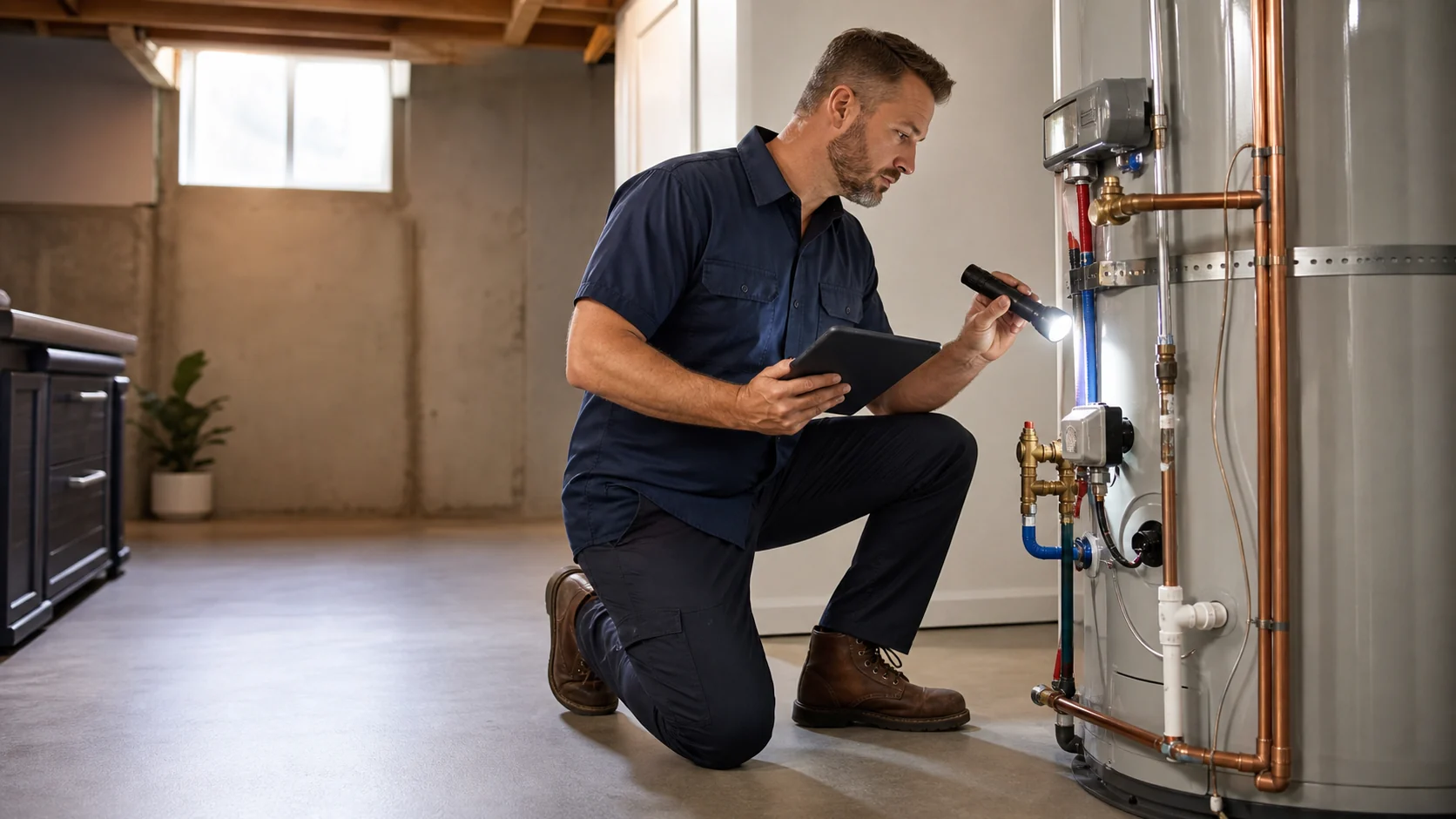
A neighbor's recalled water heater does not mean yours is included, even if the tanks look alike. Recall notices draw a much narrower line. Spend ten careful minutes with the rating plate and the official notice before assuming the heater is affected or dismissing the warning.
An urgent symptom comes before the recall search
If you smell gas, hear hissing, have a carbon monoxide alarm, see smoke or scorching, or find water reaching electrical parts, leave the unsafe area and contact the gas utility, fire department, or other appropriate emergency service. Do not wait for an online recall result. Do not remove covers, disconnect gas parts, touch wet electrical equipment, or bypass a safety control.
Start with the heater, not the receipt
Receipts and home-sale records are useful, but the installed heater is the source of truth. Equipment can be replaced without every household document being updated. Find the manufacturer's rating plate on the side of a tank or cabinet and photograph it straight on in good light.
Try to capture the brand, full model number, complete serial number, fuel or power type, tank capacity, and manufacture date if one is printed. Photograph the entire heater too. Some notices cover a control, valve, vent part, or accessory rather than the whole tank, so include any separate labels you can read without opening a panel.
Use two official checks
First, search the U.S. Consumer Product Safety Commission recall database for the brand and product type. Open the actual notice and compare every identification detail, including model formats, serial ranges, manufacture dates, photos, hazards, and remedy instructions.
Second, use the manufacturer's official support or product-literature page for the exact model. For example, A. O. Smith's product literature finder provides model-specific documents. Other brands have their own support pages and recall contacts. Type the manufacturer's web address yourself or follow the firm link shown in the CPSC notice rather than relying on a sponsored search result.
No search result is not the same as an all-clear when the label is damaged or the model cannot be identified. A manufacturer support representative or qualified local provider may need clear photos to identify the unit.
How to compare a recall notice without guessing
Read the notice line by line. The brand and general appearance are not enough. Your heater should match the affected product description and the stated model, serial, or date criteria. Some notices include an online serial checker, while others ask owners to call the recalling firm.
- Keep leading zeros, spaces, dashes, and letter suffixes when you copy the model and serial number.
- Check whether the notice refers to a complete heater or one installed component.
- Compare the manufacture date with the notice, not only the installation year.
- Use the contact information in the official notice if one character is unclear or your number falls on a range boundary.
- Save the notice URL and a screenshot or PDF with your household records.
Do not post a full serial-number photo in a public neighborhood group. Send it directly to the manufacturer, CPSC contact, or provider handling the check.
If the heater is an exact match
Follow the remedy and stop-use instructions in that specific notice. The response may involve inspection, repair, a replacement part, replacement equipment, or another remedy. Do not invent your own fix, hire someone to defeat the affected control, or keep operating the heater because it has "worked fine so far."
Before anyone arrives, ask who is responsible for the work, whether the manufacturer has an authorized service process, what records you need, and how permits or final inspection will be handled if the remedy requires replacement. Keep the case number, emails, part records, installer invoice, model and serial photos, and completion date.
If a replacement is required, the new water heater installation checklist explains which closeout records to save. The Utah permit and inspection checklist can help you ask the local building department and installer the right questions.
Watch for recall scams
An unexpected caller may know your name, address, or appliance brand and still be wrong. Confirm the notice at CPSC.gov and through the manufacturer's official website before paying anyone or sharing financial information. Do not give a cold caller card details, gift cards, passwords, remote access to a phone or computer, or a one-time security code.
A legitimate notice explains the affected products, hazard, incidents reported at publication, remedy, and recalling firm. The exact notice controls what is offered. Treat anyone who pressures you to pay immediately or replace unrelated equipment as a separate sales pitch, not proof of a recall.
A Utah homeowner's record packet
Save before the call
- • Full rating-plate photo
- • Whole-heater and room photos
- • Purchase or installation record, if available
- • CPSC notice URL
- • Current symptoms and when they began
Save after the remedy
- • Manufacturer case number
- • Work order and technician details
- • Replaced part or new equipment model
- • Permit and inspection record when applicable
- • Completion date and warranty paperwork
These records are especially useful when a heater sits in a finished basement, rental, manufactured home, or recently purchased property where the original paperwork may be incomplete. Homeowners in Salt Lake County and Utah County should use the city or county building jurisdiction for their address if replacement work needs a permit.
Sources and further reading
- U.S. Consumer Product Safety Commission: recalls - official recall notices, affected-product details, remedies, and recalling-firm contacts.
- U.S. Consumer Product Safety Commission: contact information - official channels for product-safety questions and incident reports.
- A. O. Smith: product literature - an example of a manufacturer model-document lookup. Use the official support site for the brand installed in your home.
Need help identifying the heater?
Send the brand, model and serial label, your Utah city, and the official recall link you found. If the heater has an urgent gas, carbon monoxide, fire, or wet-electrical warning, leave the unsafe area and use the appropriate emergency channel first.
Request water heater help