
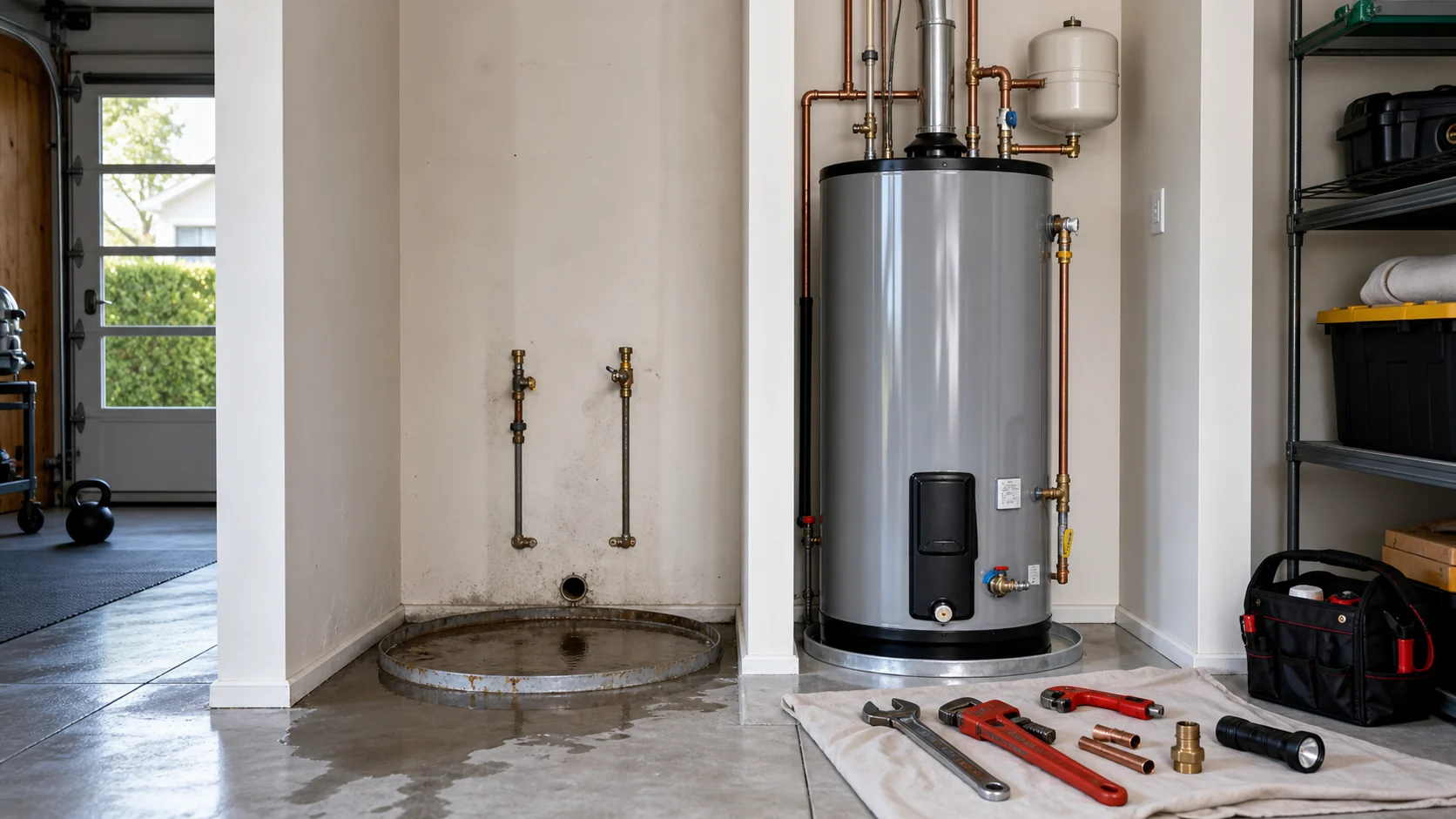
When a water heater fails, the fastest answer is often "put in the same kind." Sometimes that is the right call. But in Salt Lake County and Utah County, replacement is also the moment to check a few things that are expensive to fix later: venting, electrical capacity, room size, hot-water demand, hard-water maintenance, and whether the old setup was barely working in the first place.
Safety first: do not modify fuel or wiring yourself
This guide is for planning questions, not installation instructions. Gas piping, venting, combustion air, electrical panels, disconnects, breakers, condensate drains, and water heater permits are qualified-pro territory. If you smell gas, see scorch marks, find water near electrical parts, or have a carbon monoxide alarm, leave the area when appropriate and call the utility, emergency services, or a licensed pro.
The short version
If your current gas tank is vented safely, has enough combustion air, and your household likes the recovery speed, another gas tank may be the simplest replacement. If you want to get away from combustion appliances, an electric tank or heat pump water heater may make sense, but the panel, wiring, space, condensate drainage, and first-hour rating need a real look. Tankless can be excellent for the right home, but it is not automatically cheaper or easier, especially with Utah hard water and venting upgrades.
Gas tank replacement may fit when
- • The existing venting is safe and code-compliant
- • Hot water runs out mainly during heavy back-to-back use
- • The utility room has proper combustion air
- • You want a familiar replacement with fewer layout changes
- • A pro confirms the old flue, gas line, and drain pan setup are still acceptable
Electric or heat pump may fit when
- • Your panel has capacity, or you are already planning electrical work
- • You want to avoid combustion venting in that room
- • The heater has enough space and air volume, especially for heat pump models
- • Condensate drainage can be handled cleanly
- • You compare recovery, noise, and cold-room performance before buying
Do not compare only the sticker price
The cheapest unit on the shelf can become the wrong unit after labor, venting, wiring, pan work, expansion-tank needs, permit requirements, and comfort problems are included. A replacement quote should explain the full scope, not just the tank size.
For a fair comparison, ask each provider to separate the equipment, required code/safety updates, optional upgrades, disposal, permit handling if applicable, and any add-ons like a leak alarm or expansion tank. Then compare the comfort fit: how many showers, whether laundry and dishwashing overlap, and how quickly the unit recovers after heavy use.
Questions that matter in Utah homes
Is the current venting actually okay?
Many older gas water heaters still run, but that does not prove the venting is right. Ask about draft, corrosion, slope, shared venting, combustion air, backdrafting risk, and whether the replacement changes the venting category. Do not ignore a water heater in a tight closet, finished basement, or utility room that also has a furnace.
Can the electrical panel support the option you want?
A standard electric tank or heat pump water heater may require a dedicated circuit with the right breaker and wiring. That is not a guess-from-the-hallway item. If your panel is full, old, or already serving EV charging, basement finishing, or other large loads, have the electrical side checked before you fall in love with a model.
Will a heat pump water heater like the room?
Heat pump water heaters pull heat from surrounding air and can cool the room around them. They also need enough space, air movement, drainage for condensate, and a location where operating noise will not drive everyone crazy. A garage, basement mechanical room, or larger utility area may work better than a tiny interior closet.
Does tankless solve the real problem?
Tankless units can provide long run time when sized and installed correctly. They can also need gas-line upgrades, new venting, condensate handling, electrical power, and regular descaling in hard-water areas. If the pain point is "three showers in a row," tankless may be worth pricing. If the pain point is a leaking 14-year-old tank in a finished basement, a safer tank replacement with leak protection may be the better first move.
What to photograph before requesting quotes
- The data label. Include brand, model, serial number, gallon size, fuel type, and input rating if readable.
- The full installation. Step back far enough to show the tank, vent, gas line or electrical connection, pan, drain, and nearby walls.
- The vent path. For gas units, photograph where the vent leaves the heater and where it ties into other venting if visible.
- The electrical panel. For electric or heat pump options, share a clear panel photo with the directory label if you can do so safely.
- Problem clues. Send photos of rust, water in the pan, relief-line discharge, scorch marks, or cramped clearances.
Local note for Salt Lake and Utah County
Hard water, finished basements, tight mechanical rooms, and winter-cold garages all affect the decision. A Draper basement install, a Lehi garage install, and an older Provo utility closet may need different answers even if the old tank size is the same.
When staying with the same fuel is probably simplest
Staying with the same fuel type often reduces the number of surprises. That does not mean "same fuel, no questions." A good replacement still checks the shutoff valve, relief valve discharge path, drain pan, venting, seismic restraint, expansion tank where needed, and whether the old unit was sized correctly for the household.
If the existing heater is leaking, use the leaking water heater emergency guide first. If the tank is still working but old, compare timing with the repair-or-replace guide and the Utah replacement cost guide.
Sources and further reading
For efficiency and product-category background, review the ENERGY STAR water heater product overview and the ENERGY STAR heat pump water heater guide. For manufacturer maintenance context, see the A. O. Smith water heater maintenance guide and the manual for the exact model being installed.
What to ask before approving a replacement
• Is the fuel type staying the same or changing?
• What code or safety updates are required?
• Will the home need venting or electrical upgrades?
• Does the quote include pan, drain, disposal, and permit handling?
• How does the first-hour rating match our household?
• What maintenance will this option need in hard water?
If you are in Salt Lake City, Sandy, Draper, West Jordan, South Jordan, Murray, Provo, Orem, Lehi, American Fork, or a nearby community, send a replacement request with photos and the questions above. You will get a cleaner quote when the provider can see the real installation instead of guessing from the tank size alone.