
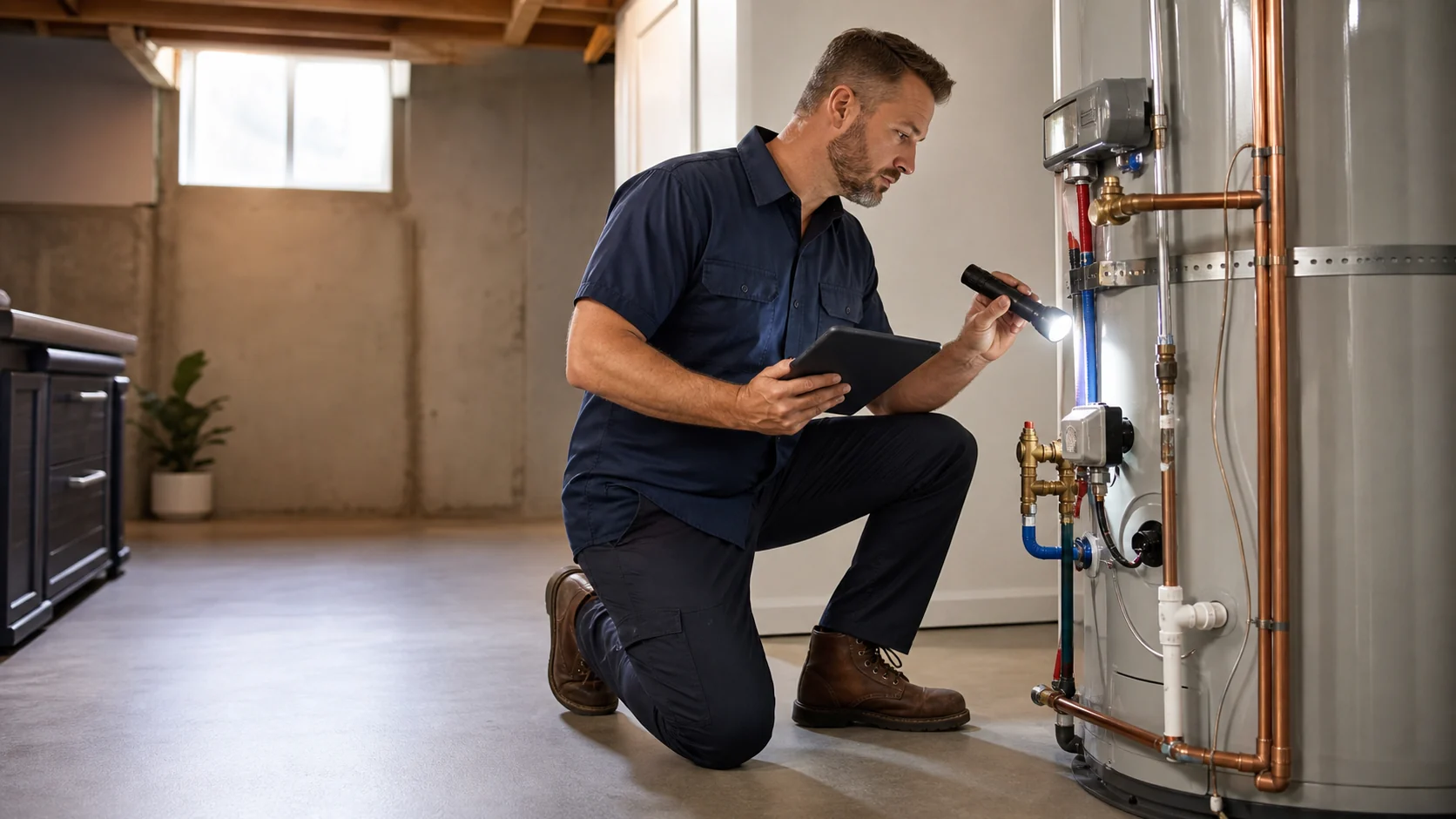
A cold shower does not automatically mean you need a new water heater. Some problems are simple service calls; others are warning signs that the tank is near the end of its useful life or no longer safe to operate. The goal is to recognize the difference before spending money on the wrong fix.
Safety first: stop if there is an urgent hazard
This guide is educational, not repair instruction. Do not relight burners repeatedly, remove electrical covers, cap or plug a relief valve, modify venting, disconnect gas lines, or work around standing water and electricity. If you smell gas, see scorching, hear hissing, notice carbon-monoxide alarm activity, or have water near electrical components, leave the area and contact the appropriate utility, emergency service, or a qualified professional.
Start with the three biggest decision factors
Most repair-or-replace decisions come down to age, safety, and total cost. Utah homes in Salt Lake County and Utah County may also deal with hard water, sediment, basement utility rooms, older venting, and code updates that affect the final recommendation.
- Age and service history: an older tank with repeated failures is less likely to be worth another repair than a newer unit with one isolated part problem.
- Safety and leak location: a leaking tank body, unsafe venting, relief-valve discharge, gas smell, or electrical concern should be treated as more urgent than a simple comfort issue.
- Repair cost compared with replacement: if a repair is expensive and the heater is already near the end of its expected life, replacement quotes may be the smarter comparison.
Signs a repair conversation may be reasonable
A qualified provider may be able to repair a water heater when the unit is not leaking from the tank itself and the issue is limited to a serviceable part or installation detail. Examples can include:
- One clear symptom on a newer unit: for example, no hot water from a relatively recent electric heater may be a thermostat, element, breaker, or wiring issue that needs diagnosis.
- Fixture-specific temperature problems: one shower running cold may point to a mixing valve or cartridge rather than the water heater.
- Tankless maintenance needs: scale buildup, inlet screen cleaning, or error-code diagnosis may be serviceable if the system was installed correctly and has isolation valves.
- Minor plumbing connection leaks: water near a fitting is different from water seeping from the tank shell, but both should be evaluated promptly.
Repair may be worth discussing
- • Newer equipment with a known model and warranty status
- • No tank-body leak or severe corrosion
- • One isolated symptom instead of repeated failures
- • Safe access for a qualified technician
Replacement should be compared
- • Older tank with multiple recent repairs
- • Water leaking from the tank body or bottom seam
- • Significant rust, bulging, or unsafe venting concerns
- • Repair quote is a large share of replacement cost
Warning signs that often point toward replacement
- Leaking from the tank itself: once the storage tank is compromised, a part replacement usually will not solve the core problem.
- Rusty hot water from multiple fixtures: compare hot and cold water. Rust isolated to hot water may point back to the water heater or hot-water piping.
- Popping plus poor recovery in an older tank: hard-water sediment can reduce performance and may be difficult to correct late in the tank’s life.
- Recurring pilot, burner, or ignition issues: gas combustion problems should be diagnosed by qualified pros, especially if venting or flame appearance seems wrong.
- Frequent relief-valve discharge: do not plug the pipe. Pressure, temperature, expansion tank, or control issues need proper evaluation.
- Capacity no longer matches the home: new bathrooms, larger tubs, basement apartments, or a growing household can outgrow a once-adequate tank.
Utah-specific factors to include in the decision
Along the Wasatch Front, mineral-heavy water can accelerate scale and sediment symptoms. Basements and tight utility rooms can add labor for removal, drain-pan routing, expansion tanks, venting corrections, or code-related updates. In cities such as Salt Lake City, Sandy, Draper, West Jordan, Provo, Orem, Lehi, and American Fork, ask each quote provider what is included beyond the equipment box: permit handling if required, haul-away, pan/drain work, expansion tank, venting, seismic strapping where applicable, and warranty registration.
If you are comparing a traditional tank to tankless, include maintenance access and water quality in the quote conversation. A tankless system can be a good fit for some homes, but only when gas sizing, venting, condensate routing, electrical needs, and future descaling are addressed correctly.
A simple rule of thumb for homeowners
If the unit is newer, safe, and the problem is isolated, get a repair diagnosis. If the unit is older, leaking from the tank, unsafe, or facing an expensive repair, compare replacement options before approving work. For borderline cases, request both a repair estimate and a replacement estimate so the tradeoff is visible.
What to gather before requesting help
- Take clear photos: rating plate, full heater, venting, drain pan, visible leak location, and surrounding access.
- Write down symptoms: no hot water, not enough hot water, leak, noise, rusty water, error code, or temperature swings.
- Estimate age: use the installation date if known, permit paperwork, home records, or serial-number information from the manufacturer.
- Note fuel and size: gas, electric, hybrid, or tankless; tank gallons if visible.
- List household needs: number of people, bathrooms, large tubs, recirculation, basement apartment, or high-demand fixtures.
Reliable external resources
For general water-heating efficiency and replacement education, review the U.S. Department of Energy water heating guide, DOE guidance on selecting a new water heater, and ENERGY STAR water heater information. For exact repair, warranty, or maintenance instructions, use the manual for your model or a qualified local provider.
Quick request checklist
• City or ZIP
• Brand and model photo
• Approximate age
• Tank size or tankless model
• Leak/noise/temperature symptoms
• Photos of access, venting, and leak area
If you are in Salt Lake County, Utah County, Salt Lake City, Sandy, Draper, West Jordan, South Jordan, Murray, Provo, Orem, Lehi, American Fork, or nearby communities and need help comparing repair versus replacement, send a water heater request with the details above. You can also review the Utah replacement cost guide, leaking water heater emergency steps, and hard-water sediment guide.