
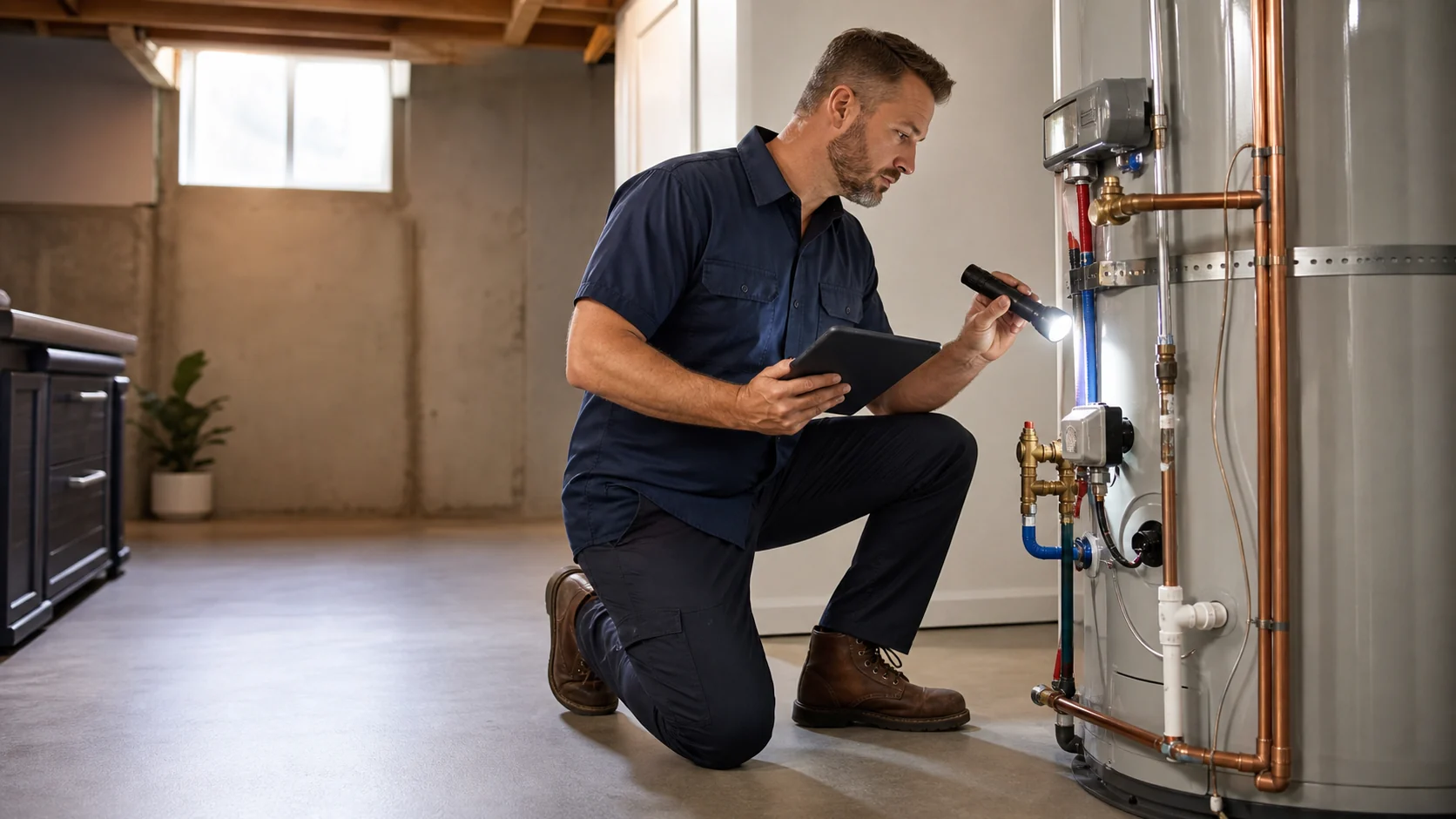
"It's the big tank in the basement" is enough to start a conversation, but it is not enough for a useful repair or replacement estimate. The same-size tank can use natural gas, propane, standard electric resistance elements, or a heat pump. Five careful photos will tell a service provider much more than the tank color ever could.
Look, photograph, and stop there
Do not remove an access panel, reach behind a hot vent, test wiring, disconnect a pipe, or handle a gas control to identify the heater. If you smell gas, leave the area and call the gas utility or emergency services from a safe location. Water near wiring, scorching, soot, a carbon monoxide alarm, or an active tank leak also needs prompt qualified help.
Start with the rating plate
Look for a printed label or metal plate on the side of a tank or the outer cover of a tankless unit. Use your phone's flashlight and take one wide photo plus one close photo. Keep serial numbers private when posting in a public forum, but include the following details in a private service request:
- manufacturer, full model number, and serial number
- fuel or energy source, such as natural gas, LP/propane, or electric
- tank capacity in gallons, if it has a storage tank
- input rating in BTU per hour or electrical ratings in volts, amps, or watts
- Uniform Energy Factor, first hour rating, or maximum flow information if shown
Do not rely on a partial model name from the front badge. The full model number on the rating plate identifies the series, size, fuel, and often the venting or efficiency configuration. If the label is damaged or blocked, photograph the whole installation and any paperwork instead of moving the heater.
Match the visible clues
Do not identify fuel from one clue alone
A nearby gas pipe does not prove the heater uses gas; it may serve a furnace or dryer. A power cable does not prove a unit is all-electric because many modern gas heaters need electricity for ignition, controls, fans, or pumps. A vent is strong evidence of combustion, but vent shapes and materials vary by model. The rating plate is the deciding source.
Propane deserves its own check. Natural-gas and LP equipment are not interchangeable just because both burn gas. Send a clear photo of the fuel line and the exact fuel statement on the label. Do not attempt a fuel conversion or assume one was done correctly.
Tankless, heat pump, and power-vent details matter
"Tankless" describes how the unit heats water, not its fuel. A tankless heater can be gas-fired or electric. A gas unit can be condensing or non-condensing, and some have built-in recirculation. Those details affect venting, drainage, maintenance, available flow, and replacement scope.
A heat pump water heater still stores hot water in a tank and normally includes electric resistance elements for backup or high-demand modes. The large top section, air grilles, and condensate line distinguish it from a standard electric tank. ENERGY STAR notes that heat pump units use electricity to move heat from the surrounding air into the water instead of generating all their heat directly. Room temperature, air space, condensate drainage, and noise therefore matter when comparing replacements.
Some gas storage heaters use a powered fan rather than a traditional draft hood. Photograph the top of the heater and the complete vent path that is safely visible. Do not call it a standard atmospheric gas tank based only on its cylinder shape.
The five-photo service packet
- Whole installation: stand back far enough to show the heater, floor, nearby walls, and access space.
- Rating plate: capture the full label in focus, including model, serial, fuel, capacity, and electrical or BTU data.
- Top connections: show the visible hot and cold piping, vent, expansion tank, and any corrosion without reaching over hot equipment.
- Lower controls: photograph them from outside the unit. Leave covers and burner doors closed.
- Problem area: show the leak trail, error code, corrosion, or clearance problem, then add a wider photo so the location makes sense.
For homes in Salt Lake County and Utah County, mention whether the heater sits in a basement, garage, attic, utility closet, or finished living area. Cold garages can affect winter performance, while tight closets and finished basements can change access and water-damage planning.
What not to guess before asking for a quote
Tank capacity does not tell you how much hot water the household will get during its busiest hour. A tank's first hour rating and a tankless unit's flow at the required temperature rise are better sizing clues. Utah's colder winter inlet water can reduce tankless flow at a comfortable outlet temperature, so a headline gallons-per-minute number needs context.
Use the Utah sizing worksheet to document peak use. If replacement is likely, the gas-versus-electric comparison and quote checklist will help you compare the exact model and installation scope rather than a vague "40-gallon replacement."
Sources and further reading
- ENERGY STAR: heat pump water heaters explains how heat pump models move heat from surrounding air and covers installation considerations.
- Rinnai: tankless water heaters provides a manufacturer example of gas tankless product types, condensing configurations, and model information. Use the manual for your exact unit.
- Federal Trade Commission: using the EnergyGuide label explains the label's energy-use and operating-cost comparisons when shopping for a replacement.
Not sure what is in the utility room?
Send the five photos, your Utah city, the symptoms, and any error code. Keep the cabinet closed and let the label do the identifying.
Request Utah water heater help