Water that feels “just a little too hot” can become a real safety issue for children, older adults, guests, and anyone with limited mobility. For many Utah homes, the simplest starting point is to confirm whether the water heater is set near 120°F and whether fixtures deliver hot water consistently without sudden spikes.
Safety first: do not guess with gas or electricity
This guide is homeowner education, not repair instructions. Do not remove electrical covers, bypass thermostats, modify gas controls, cap relief valves, or change wiring. If the water heater is leaking, scorched, near standing water, smelling of gas, or behaving unpredictably, stop and contact the appropriate utility, emergency service, or qualified local water heater professional.
Why 120°F is the usual starting point
The U.S. Department of Energy commonly recommends lowering water heater temperature to about 120°F for energy savings and to reduce scald risk. The U.S. Consumer Product Safety Commission also warns that hot tap water can cause serious burns and points homeowners toward safer temperature practices.
That does not mean every household is identical. Dishwashers, manufacturer instructions, plumbing layout, local code requirements, medical considerations, and anti-scald devices can all affect the right setup. Treat 120°F as the practical homeowner checkpoint, then ask a qualified provider if your home has special needs.
Who is most at risk from overly hot water?
- Young children: bath and sink water can burn sensitive skin quickly.
- Older adults: slower reaction time, thinner skin, and mobility limitations can increase injury risk.
- Guests and renters: people who do not know the home may not expect very hot fixtures.
- Basement apartments or multi-bath homes: long plumbing runs and fixture differences can make temperature feel inconsistent.
Homeowner checks that are reasonable
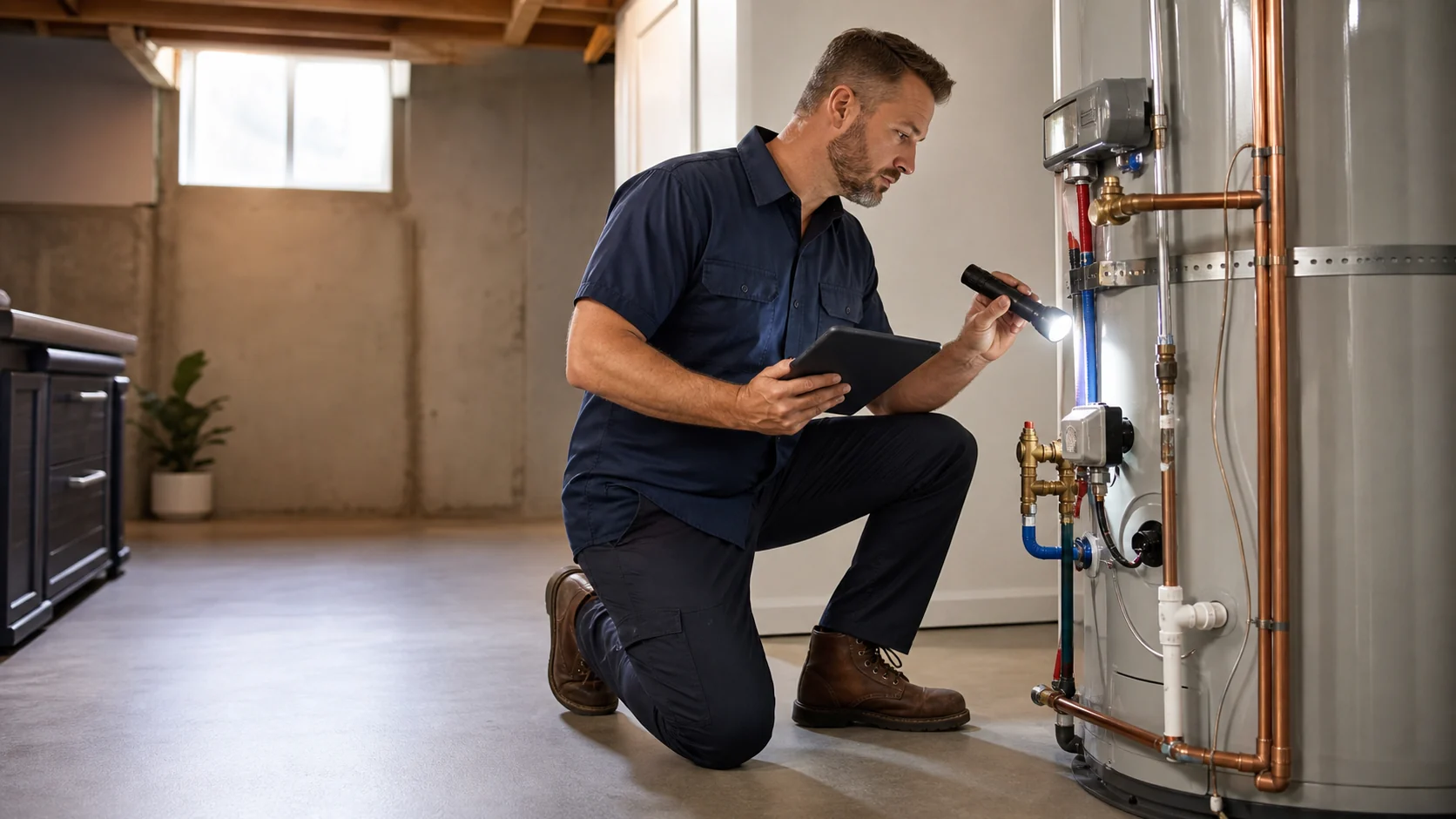
- • Read the visible temperature dial or digital display
- • Measure hot water at a fixture with a kitchen thermometer
- • Note which sinks or showers feel too hot or too cold
- • Save model photos before requesting help
Call a pro before adjusting
- • Electric panels or access covers must be removed
- • Gas controls are confusing or damaged
- • Water temperature swings suddenly
- • Relief valve, mixing valve, or recirculation issues are suspected
How to check delivered hot water without taking the heater apart
- Choose a frequently used sink. A kitchen or bathroom sink is usually easier to measure than a shower.
- Run hot water until the temperature stabilizes. Keep hands clear if the water may be very hot.
- Fill a cup and measure with a cooking thermometer. Write down the highest stable temperature.
- Repeat at another fixture. A large difference may point to fixture mixing, plumbing layout, or a tempering valve issue rather than the tank alone.
- Document symptoms. Include “too hot,” “not hot enough,” “temperature swings,” or “only one bathroom affected” when requesting help.
When hotter is not the same as better
Turning the water heater up can hide a capacity problem for a while, but it can also increase scald risk, standby heat loss, mineral buildup, and stress on older equipment. In Salt Lake County and Utah County homes with hard water, higher temperatures may make scale and sediment problems more noticeable over time.
If the household runs out of hot water quickly even at a normal setting, the better question may be whether the tank is undersized, full of sediment, aging, or serving new fixtures and higher demand. Start with the Utah hard-water sediment guide and the replacement cost guide before assuming the dial should simply go higher.
Mixing valves and anti-scald devices
Some systems use thermostatic mixing valves or anti-scald shower valves to blend hot and cold water before it reaches fixtures. These devices can improve safety, but they can also fail, drift, clog with minerals, or be installed incorrectly. If one fixture is much hotter or colder than others, the water heater may not be the only cause.
Do not disable anti-scald protection to get hotter water. Ask a licensed plumbing professional whether a valve needs service, replacement, or adjustment according to manufacturer instructions and local code.
Temperature symptoms that deserve prompt attention
- Sudden scalding water: possible control, thermostat, mixing valve, or installation issue.
- Only lukewarm water: possible element, gas burner, dip tube, thermostat, sediment, or tankless error issue.
- Hot-cold-hot swings: possible fixture cartridge, tankless flow, recirculation, or mixing problem.
- Relief valve discharge: never cap the line; have pressure and temperature issues evaluated.
- Gas smell, scorching, or water near electrical components: stop using the area and seek urgent help.
Reliable external resources
For safety and efficiency background, review the U.S. Department of Energy guide to lowering water-heating temperature, the DOE hot-water energy-saving tips, and the CPSC tap-water scald prevention bulletin. For exact adjustment steps, use your manufacturer manual or hire a qualified provider instead of following random short videos.
What to include in a temperature-related service request
• City or ZIP
• Tank or tankless brand
• Measured fixture temperature
• Too hot, too cold, or fluctuating?
• Which fixtures are affected
• Photos of label and visible controls
If you are in Salt Lake City, Sandy, Draper, West Jordan, South Jordan, Murray, Provo, Orem, Lehi, American Fork, or nearby Utah communities and your water temperature seems unsafe or unreliable, send a water heater request with the details above.