
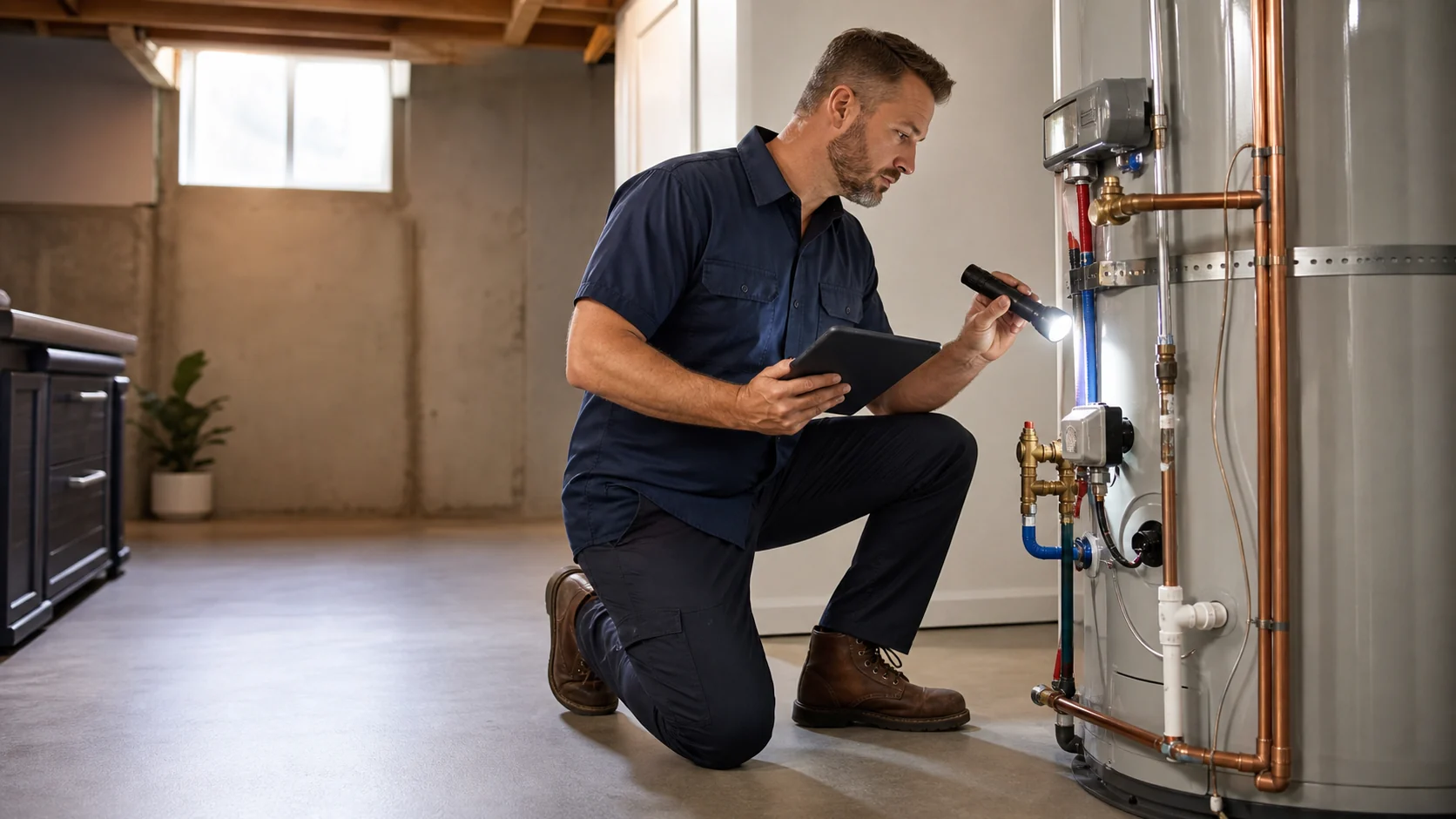
A few inches of water in a basement or utility room can reach the lowest, most sensitive parts of a water heater: gas controls, burners, wiring, insulation, and electrical connections. The puddle may disappear long before corrosion or contamination does. That is why “it looks dry” is not a useful safety test.
Do not walk into an energized flooded area
If standing water may be touching the water heater, electrical panel, outlets, wiring, extension cords, or appliances, stay out. Do not reach through water to unplug equipment or operate a breaker. Have the utility or a qualified electrician confirm that the area is safe. If you smell gas, leave immediately without using switches, flames, phones, or vehicles near the odor. Call 911 and the gas utility from a safe location.
The first hour: what to do and what to leave alone
- Keep people and pets out. Close the door or block access if you can do so without entering water.
- Do not test the heater. Do not turn up a thermostat, press a reset button, relight a pilot, plug in a pump, or restore power to see whether it still works.
- Call the right safety help first. An electrical hazard belongs with the power utility or a qualified electrician. Gas odor calls for evacuation and the gas utility or 911. Active water that cannot be stopped safely may require the water utility, building maintenance, or an emergency plumber.
- Document from dry ground. Photograph the room, visible water line, heater label, nearby equipment, and the source of water if it is safe to do so. Do not step closer for a better picture.
- Contact your insurer. Ask what photos, estimates, mitigation records, and damaged-property documentation the claim requires before equipment is removed.
A burst supply line, drain backup, spring runoff, and groundwater intrusion can leave very different contaminants behind, but none of them makes an exposed electrical or gas control safe to test. Floodwater can carry sewage, chemicals, dirt, and conductive residue. Drying alone does not remove that damage.
How to describe the exposure accurately
“The water heater flooded” can mean anything from a damp floor nearby to water halfway up the tank. A plumber, electrician, manufacturer, or insurer can make a better decision when you give them a clear water line and equipment details.
Why gas and electric heaters both need caution
On a gas tank, floodwater can reach the burner compartment, ignition parts, gas control, sensors, and vent-related components near the bottom of the unit. Do not relight the pilot or operate a wet gas control. The absence of a gas smell does not prove that the equipment is ready to run.
On an electric tank, water can affect wiring, thermostats, heating-element connections, insulation, and the branch circuit. A heat-pump water heater adds fans, controls, sensors, and a compressor system. Tankless units may be mounted above the water line, but their receptacle, disconnect, condensate equipment, remote controls, or nearby wiring can still be exposed.
The Electrical Safety Foundation International warns that water-damaged equipment can carry long-term fire and shock risks even after it has dried. It recommends evaluation by qualified professionals before power is restored. The practical takeaway is simple: a successful restart would not prove that hidden corrosion or contaminated components are safe.
Inspection, repair, or replacement?
There is no honest one-rule answer based only on water depth. The decision depends on what got wet, the equipment design, the type of water, manufacturer instructions, code requirements, available parts, unit age, and the cost of restoring it safely. Some electrical equipment must be replaced after water exposure; other equipment may be eligible for manufacturer-approved reconditioning by qualified people. A homeowner should not make that call by drying a component and trying it.
Ask the evaluating contractor to put the recommendation in writing. If replacement is advised, request the exact reason and a line-item quote. If repair is proposed, ask which exposed parts will be replaced or reconditioned, whose procedure permits that work, and how the complete system will be tested before return to service.
Questions for the inspection
- • Which components were below the water line?
- • Does the manufacturer permit repair or reconditioning after this exposure?
- • Does an electrician also need to inspect the circuit, receptacle, disconnect, or panel?
- • Are gas controls, venting, or combustion parts affected?
- • What testing and documentation will show that the system is ready for service?
Save this claim file
- • Date, time, cause, and maximum water depth
- • Room and equipment photos
- • Model, serial number, and installation date if known
- • Utility, mitigation, plumber, and electrician visit records
- • Written repair and replacement recommendations
Before the heater returns to service
Cleanup and appliance work are separate jobs. Removing water and drying the room does not clear the heater, its fuel supply, or its electrical circuit for use. Wait for the qualified people involved to say what can be energized, what must be replaced, and who will perform the startup.
If the unit is replaced, use the moment to reduce the next loss. Depending on the room, that discussion may include a properly drained pan, a leak alarm or automatic shutoff, a better floor drain, safe elevation permitted by the manufacturer, and keeping boxes away from the heater. Read the leak-prevention guide before comparing options, then use the Utah quote checklist to review the full scope.
Sources and further reading
- Electrical Safety Foundation International: Flooding and disaster safety — why submerged electrical equipment should not be touched and why exposed equipment needs professional inspection.
- Electrical Safety Foundation International: Water-damaged electrical equipment — replacement, reconditioning, contamination, and return-to-power guidance.
- FEMA P-348: Protecting building utility systems from flood damage — a technical reference for flood exposure and future mitigation planning.
Need a water-heater assessment after water damage?
Once the area is safe, send your Utah city, heater type, model if known, highest water line, and dry-location photos. We can help route the request for a repair-versus-replacement assessment.
Send the water-damage details