
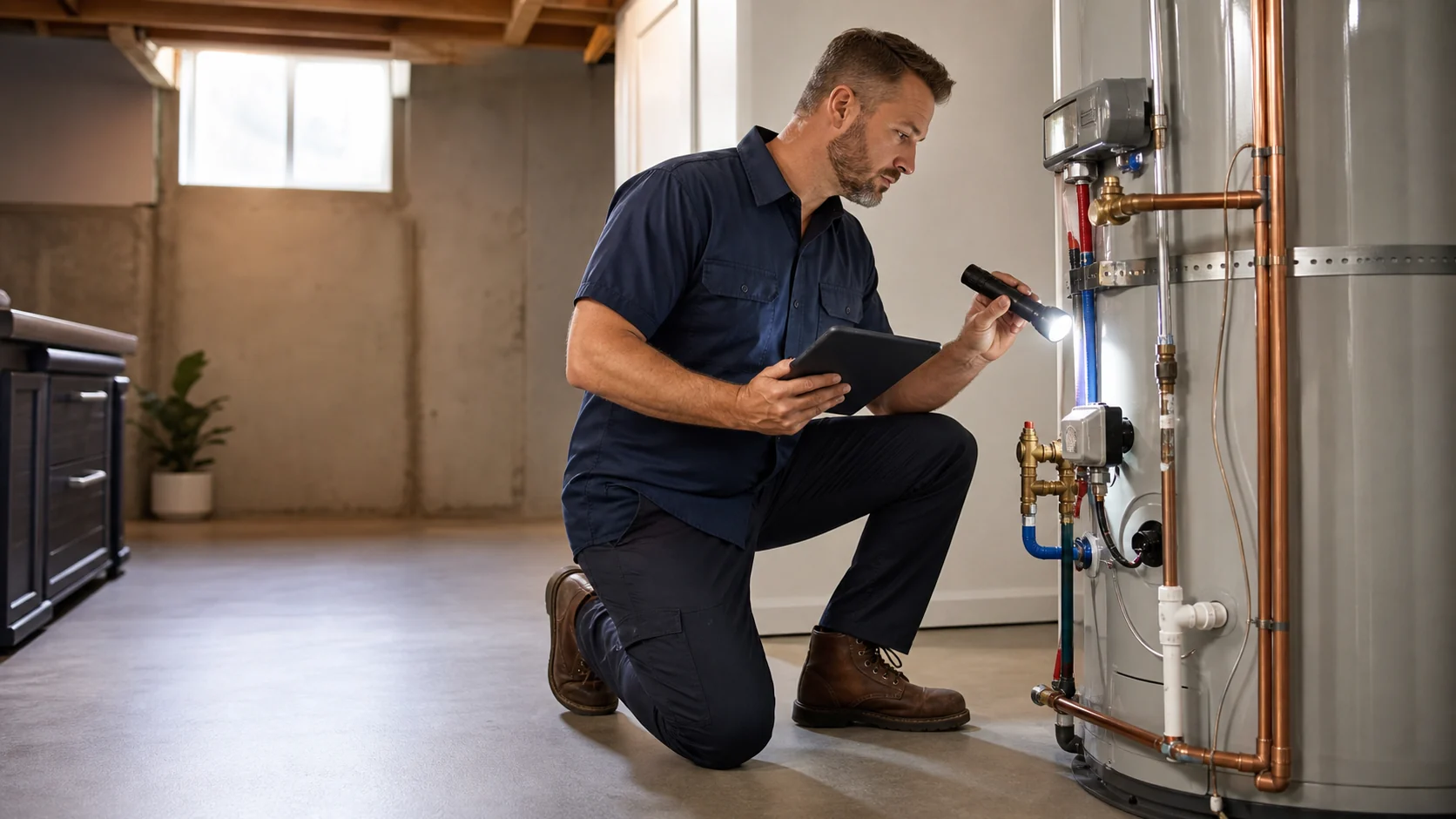
The shower takes a while to warm up, so the foam sleeves at the hardware store look like an easy fix. Sometimes they are worth adding. The useful question is what problem you are trying to solve. Insulation slows heat loss through the pipe wall. It does not make water move faster from a basement heater to an upstairs bathroom.
Stop before wrapping anything near heat or controls
Do not cover a draft hood, flue, gas control, relief valve, discharge pipe, electrical cover, shutoff, union, leak, or corroded fitting. The U.S. Department of Energy's weatherization job aid calls for at least 6 inches of clearance between pipe insulation and a draft diverter or single-wall vent. Your heater manual and local requirements take priority. If the piping is crowded around a gas vent or you cannot identify the parts, ask a qualified plumber or weatherization professional to handle it.
What pipe insulation changes
Hot water cools while it sits in exposed piping. A sleeve adds resistance between the pipe and the surrounding basement, garage, crawlspace, or utility room. The water left in that section stays warm longer, and the heater loses less energy through nearby piping.
The difference is easiest to notice when the same fixture is used again after a short pause. For example, the kitchen tap may still deliver warm water after dinner cleanup instead of starting completely cold. A shower at the far end of the house will still need the old water in the line to clear before newly heated water arrives.
Where the first effort usually belongs
The Department of Energy weatherization job aid focuses on the first 6 feet of accessible inlet and outlet piping and calls for correctly sized insulation with a minimum R-3 rating. That is a professional standard, not a command to wrap every pipe exactly the same way. Heat-pump, tankless, gas, and electric equipment have different layouts and service needs.
Start by identifying accessible straight runs that are clearly water pipes and well separated from hot venting, valves, controls, and damaged fittings. A long exposed hot line in an unfinished Utah basement may be a more sensible target than a few inches squeezed between a gas heater and its draft hood.
A five-minute observation before buying material
- Find the heater label and note whether the unit is gas, electric, heat pump, or tankless.
- Take a wide photo of the heater, the piping above it, and any vent or electrical connection.
- Follow only the visible, accessible pipe route. Do not remove panels, ceiling material, or existing insulation.
- Note bare pipe lengths, outside diameter, elbows, valves, corrosion, moisture, and tight clearances.
- Time how long two or three fixtures take to become hot. This separates a whole-house pattern from one slow branch or fixture.
If the main complaint is the wait at a distant fixture, use the slow hot-water delivery guide before assuming insulation is the answer. If showers turn cold after a predictable amount of time, the not-enough-hot-water checklist is the better starting point.
Utah winter reality: insulation is not a freeze guarantee
Foam sleeves slow heat movement. They do not create heat. A water line in an unheated garage wall, vented crawlspace, or drafty exterior cabinet can still freeze during a Wasatch Front cold snap. The risk depends on the pipe location, air leaks, duration of the cold, and whether heat reaches the space.
Do not use a torch, open flame, or improvised high-heat device on a frozen or suspected frozen pipe. A split may not show itself until the ice thaws. Shutoff access and a professional assessment matter more than another layer of foam when a pipe has frozen before.
Material and quote questions that prevent a sloppy job
- What insulation size matches the pipe outside diameter without a compressed or open seam?
- What R-value is specified for this location?
- Which valves, unions, labels, controls, and service points must remain visible?
- How will clearance be maintained from the draft hood, flue, and other hot components?
- Is the existing pipe dry and sound, or does corrosion need attention first?
- For an exterior or unconditioned area, what protects the plumbing if the room drops below freezing?
Those questions are more useful than asking for a blanket promise that insulation will fix a slow fixture. A contractor should be able to explain what will change and what will not.
When to skip the hardware-store project
- The heater is gas-fired and the target pipe is close to the draft hood or vent.
- You see moisture, mineral crust, green staining, rust, a swollen fitting, or a sagging pipe.
- The only accessible section is crowded with controls, valves, wiring, or relief components.
- The pipe has frozen before or runs through an unheated exterior space.
- The heater is leaking, making new noises, tripping a breaker, losing its pilot, or producing inconsistent temperatures.
A service visit can deal with the underlying fault and identify safe insulation boundaries at the same time. Covering a weak fitting only makes the next inspection harder.
Sources and further reading
- U.S. Department of Energy: Insulate Domestic Hot Water Pipes job aid, including R-value, coverage, seam, and combustion-vent clearance guidance.
- U.S. Department of Energy: Reduce Hot Water Use for Energy Savings, for the larger water-heating efficiency picture.
Use the installation manual for your exact model before work begins. Manufacturer clearances and warnings can differ by heater type.
Not sure whether the problem is heat loss or the heater?
Send your city, heater type, fixture wait times, and a wide photo of the accessible piping. A qualified local provider can check the equipment and point out where insulation is appropriate.
Request local help