
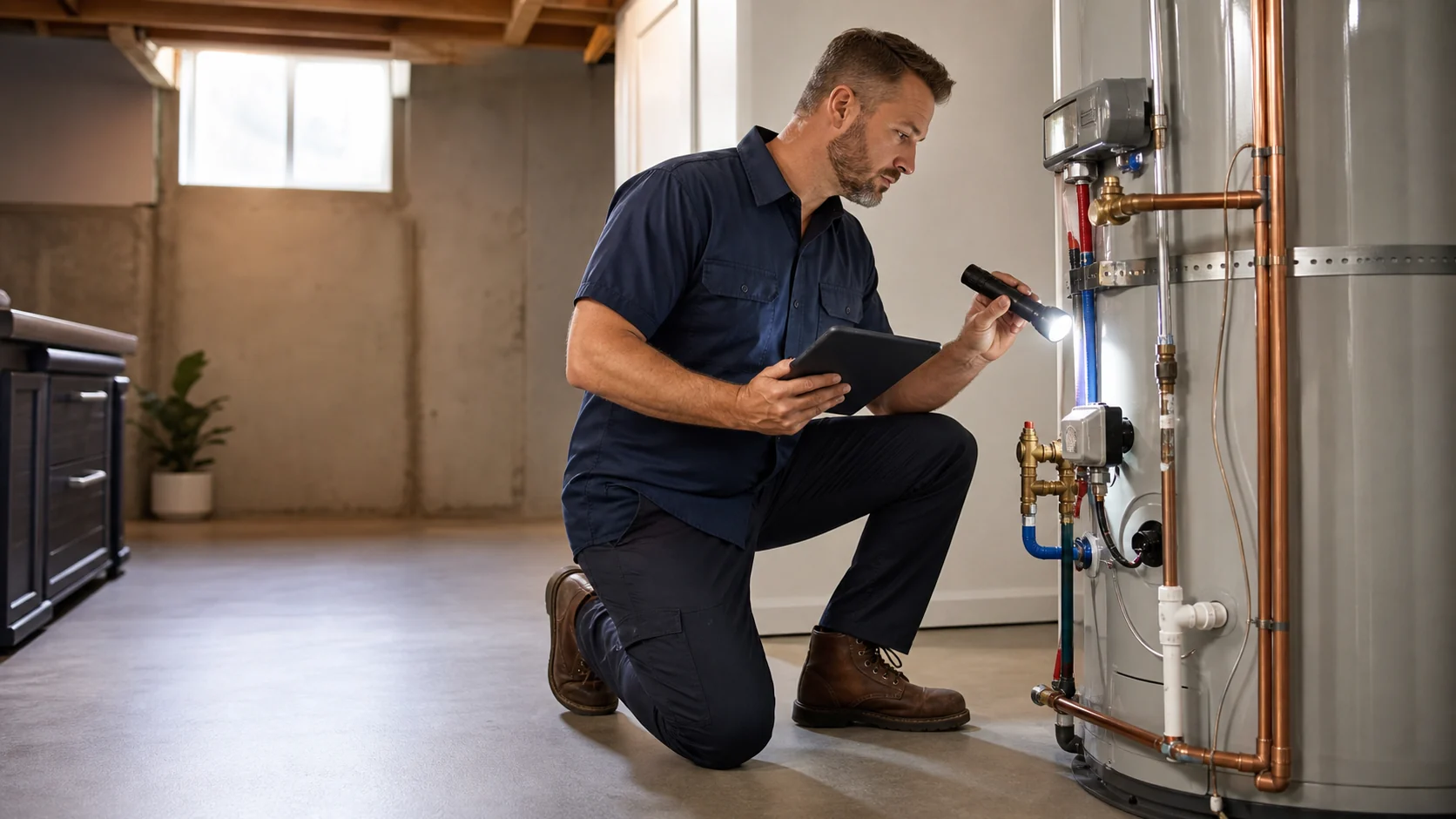
Weak hot water is annoying because it feels simple until you start testing it. The shower trickles, the kitchen sink is fine, the washer takes forever, or the tankless unit works at one tap but not two. In Salt Lake County and Utah County homes, mineral buildup can be part of the story, but it is not the only suspect.
Safety first: do not open gas, electrical, or pressure parts
This guide is for safe observation. Do not remove burner covers, electrical panels, thermostats, gas controls, pressure relief parts, tankless covers, or plumbing connections to chase a pressure problem. If low flow comes with a leak, scorch marks, gas odor, relief-valve discharge, breaker trips, or a burning smell, step back and request qualified help.
Start with the pattern, not the water heater
The fastest way to avoid a bad diagnosis is to check where the low pressure shows up. A single slow faucet often points to an aerator, cartridge, fixture valve, or supply line. Every hot tap running weak is more likely to involve the water heater, a valve near it, a mixing valve, sediment, or a whole-home pressure issue.
Utah hard water can shrink the margin
Hard water leaves scale behind as heated water moves through fixtures, valves, tankless heat exchangers, and older plumbing. That does not mean every low-flow complaint is a sediment emergency. It does mean small restrictions can stack up over time, especially in homes around Salt Lake City, Sandy, Draper, West Jordan, South Jordan, Provo, Orem, Lehi, and American Fork where mineral-heavy water is common.
If pressure has been fading for months, combine this guide with the hard-water and sediment guide. If the heater is older and you are seeing rusty hot water, rumbling, slow recovery, or leaks, use the repair-or-replace checklist before spending money on repeated small fixes.
Safe checks homeowners can do
- Compare hot and cold at the same fixture. If both are weak, the water heater may not be the main problem.
- Try more than one fixture. Test a bathroom sink, kitchen sink, shower, and laundry connection if you can do it safely.
- Look for a recent change. New showerheads, faucet work, a replaced softener, a closed valve after service, or city water work can change flow.
- Check visible shutoff handles only. If a handle near the heater looks partly turned and you are unsure what it controls, take a photo for a plumber instead of forcing it.
- Watch for leak clues. Wet pans, damp drywall, stained ceilings, or water near electrical parts move the issue from annoying to urgent.
Good details to send with a request
- • City or ZIP and whether the heater is in a basement, garage, closet, or utility room
- • Tank or tankless brand, fuel type, and approximate age
- • Which fixtures are weak and whether cold water is normal
- • Whether the problem started suddenly or faded over time
- • Photos of the heater label, visible valves, any leak, and any tankless error code
Shortcuts to avoid
- • Do not raise the temperature to compensate for weak flow
- • Do not cap, plug, or redirect a pressure relief line
- • Do not open tankless, gas, or electrical covers
- • Do not force stuck valves or old fittings
- • Do not ignore weak flow paired with leaks, burning smells, or breaker trips
Tankless low-flow problems need a different conversation
Tankless units have minimum flow rates and maximum output limits. A unit that worked in summer may struggle during colder inlet-water months, and scale can make that worse. If one shower is fine but two showers turn lukewarm, the issue may be sizing, maintenance, filter screens, descaling, or gas/electrical supply rather than a simple pressure fix.
Start with the tankless maintenance guide and the tankless installation guide. For service requests, include the unit model, error codes, how many fixtures were open, and whether the home has a softener.
When low hot-water pressure should be checked soon
- Low flow appears suddenly after a water heater repair, replacement, or softener/filter change.
- Every hot fixture is weak but cold water still feels normal.
- The heater is older and low flow appears with rust, popping noises, slow recovery, or leaks.
- A tankless unit shows error codes, repeated ignition attempts, or flow changes after skipped maintenance.
- You see water near the heater, relief pipe, drain valve, or finished-basement walls.
Sources and further reading
For fixture flow context, the EPA WaterSense showerhead page explains modern showerhead flow limits and why fixtures can affect perceived pressure. For maintenance background, A. O. Smith's homeowner maintenance guide covers routine water heater observations and the importance of following the manual for your exact model. Use manufacturer manuals and local code as the final source for any service work.
Request help with weak hot water in Utah
If you are in Salt Lake County, Utah County, or nearby Wasatch Front communities, send the fixture pattern, heater age, photos, and any leak or error-code details. A clear pattern is more useful than a guess.
Send water heater details