
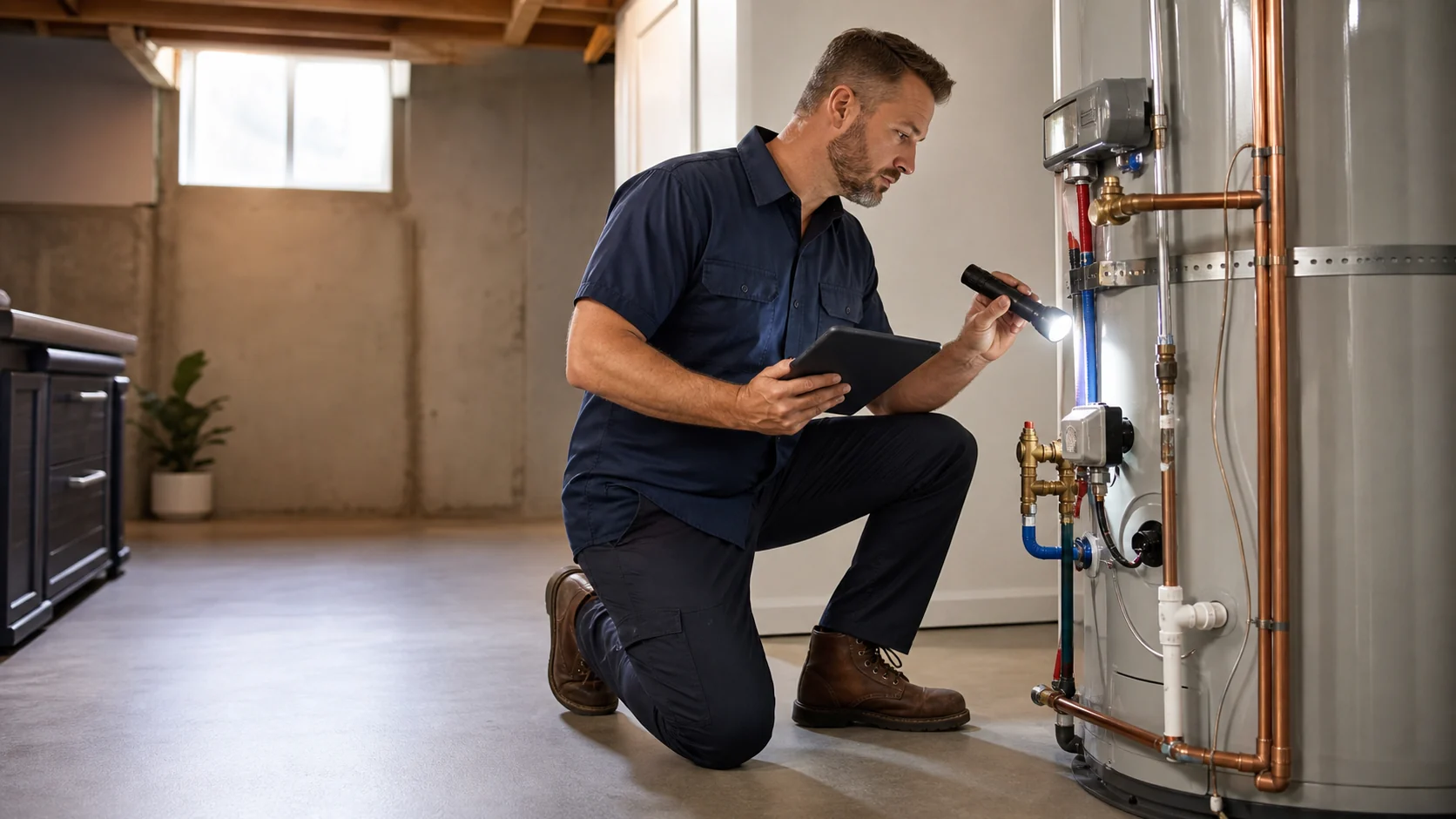
A small tank above or near the water heater is easy to ignore until something starts dripping. In many Utah homes, that little tank is part of the pressure-control story. It gives heated water a place to expand when the plumbing system cannot push that extra volume back toward the street.
Safety first: pressure problems are not a DIY guessing game
This guide is for homeowner observation and service planning. Do not cap or plug a relief valve, remove a discharge pipe, adjust a pressure-reducing valve, drain a hot tank, cut into water lines, or add air to an expansion tank unless you are trained to do it safely. If the relief valve is actively discharging, hot water is spraying, the tank is bulging, or water is near electrical parts, keep clear and request urgent help.
What an expansion tank does
Water expands when it heats. In an older open plumbing system, that extra pressure may be able to move back toward the main line. Many homes have devices that limit backflow, such as pressure-reducing valves, check valves, meters with backflow protection, or irrigation-related protection. Once the system is effectively closed, the water heater may need another safe place for expansion to go.
That is the job of a thermal expansion tank. It usually has an air side and a water side separated by an internal bladder or diaphragm. When pressure rises during a heating cycle, a properly sized and charged expansion tank can absorb some of that pressure instead of forcing the relief valve, fixtures, or the water heater tank to take the hit.
Why Utah homeowners run into this
Along the Wasatch Front, water heater closets and basement utility rooms often get remodeled, pressure regulators get replaced, softeners get added, and old water heaters get swapped without the homeowner ever seeing the full pressure picture. Salt Lake County and Utah County also have plenty of hard-water homes, which can make minor leaks, crusty fittings, and noisy tanks show up sooner.
If you are replacing a water heater in Salt Lake City, Sandy, Draper, West Jordan, South Jordan, Murray, Provo, Orem, Lehi, or American Fork, ask the installer to look at incoming pressure, closed-system conditions, the expansion tank, and relief piping at the same visit. It is easier to fix the setup while the system is already being evaluated.
Signs the expansion setup needs attention
Safe checks before you request service
- Look for a small expansion tank on the cold-water side near the water heater. It may be mounted above, beside, or close to the unit.
- Photograph the water heater, top connections, relief valve pipe, any pressure regulator, and the expansion tank label if you can read it without moving anything.
- Check whether the relief discharge pipe ends near the floor and points safely downward. Do not modify it.
- Write down when dripping happens: during recovery after showers, overnight, after laundry, or constantly.
- Check the water heater age and fuel type from the label if the label is easy to see.
- Keep stored boxes, cleaners, paint, and holiday bins away from the heater so leaks and shutoffs are visible.
Questions to ask a plumber
- • Is my plumbing system closed because of a pressure regulator, check valve, meter, or backflow device?
- • What is the incoming water pressure, and is it within a safe range for my fixtures and heater?
- • Is the expansion tank correctly sized for this water heater and house pressure?
- • Is the tank charged correctly and installed on the right side of the system?
- • Does the relief valve or discharge pipe need replacement or correction?
Leave this work to a pro
- • Installing or replacing an expansion tank
- • Testing or replacing the temperature and pressure relief valve
- • Adjusting house pressure or a pressure-reducing valve
- • Cutting, soldering, or re-piping water lines
- • Diagnosing repeated relief-valve discharge on a gas or electric water heater
When this affects repair-or-replace decisions
An expansion tank problem does not automatically mean the water heater is finished. Sometimes the fix is pressure-related. Sometimes the water heater, relief valve, regulator, or connected piping has more going on. Age matters too. If the heater is near the end of its expected life, has rust at the base, makes rumbling sediment noises, or has leaked from the tank body, compare repair and replacement before paying for piecemeal work.
Use the repair-or-replace checklist if the tank is older or leaking. If you are seeing water around the heater now, start with the leaking water heater emergency guide. For hard-water symptoms that show up with noise or sediment, see the Utah hard water and sediment guide.
Sources and further reading
For general water-heater safety and manufacturer education, see the A. O. Smith water heater info center. For a plain-English overview of thermal expansion, see PlumbingSupply.com's thermal expansion explanation. Use your installed unit's manual, local code requirements, and a qualified Utah plumber for final decisions on your home.
Seeing pressure symptoms or relief-valve drips?
Send the city, water heater age, fuel type, photos of the expansion tank area, and a note about when the dripping or pressure symptom happens. A local provider can tell you whether this should be a repair visit, replacement quote, or pressure inspection.
Send water heater details