
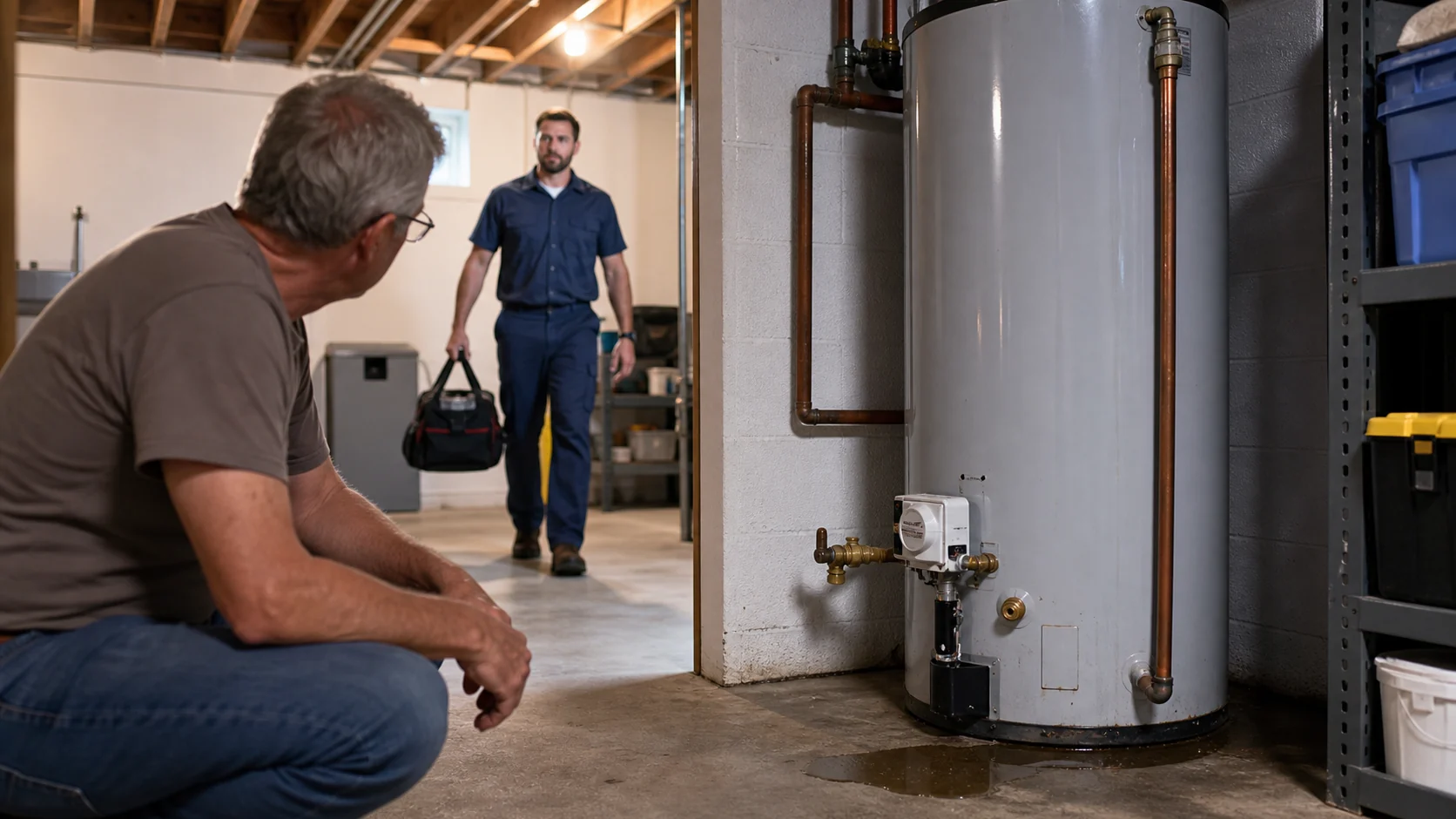
You spot a shiny ring of water around a pipe on top of the heater. By the time you look again, the insulation jacket is wet and there is a puddle at the base. That does not automatically mean the tank has failed, but it is not a leak to put off. Water running down from the top can reach gas controls, electrical parts, drywall, and finished basement flooring.
Step back if water and energy could meet
Do not reach through water to touch a plug, breaker, control, or shutoff. If water is spreading, spraying, entering an electrical cover, or running onto a burner, request urgent qualified help. Leave immediately if you smell gas or a carbon monoxide alarm sounds. Do not tighten hot fittings, remove the top cover, open access panels, or plug a relief pipe.
Start above the puddle
Water follows gravity, but it also follows pipes and seams. A puddle beside the tank may have started several feet higher. If the area is safe to view, use a flashlight and look for the highest bead of water, fresh mineral trail, or rust mark. Take one wide photo of the heater and nearby plumbing, then close photos of each wet point.
Dry only the easy-to-reach exterior surfaces and floor. Do not wrap a towel around a hot pipe or put your hand behind a fitting. Check again after a shower or appliance cycle and after the system has been idle. The timing helps separate a constant pressurized leak from water that appears only while the heater is recovering.
Four places a top leak often starts
Mineral crust is a clue, not a diagnosis
White, tan, blue-green, or rusty deposits around a top connection can show that water has dried there before. Hard water across Salt Lake County and Utah County can make those deposits obvious. An old stain may be dry today, while a clean-looking connection can still have a new pinhole leak. Look for fresh moisture and changing patterns instead of judging the fitting by color alone.
Do not scrape deposits, twist a connector, or lean on piping to see whether it moves. Corroded parts can break with little warning, and a hot-water connection can release scalding water under pressure.
When the top fitting is not the real source
Check the room before blaming the heater. Water can drip from an overhead plumbing line, furnace or heat-pump condensate drain, water softener connection, humidifier line, or a garage wall after rain or snow. On a heat pump water heater, condensate belongs in its intended drain path. Water running outside that path still needs attention.
A gas tank may also produce temporary condensation when cold inlet water meets hot combustion surfaces, especially after a long draw. That moisture should taper as the tank warms. A bead that keeps forming at the same plumbing joint or water that appears when the burner has not run points elsewhere. The condensation-versus-leak guide has a timing checklist.
Decide how urgent the call is
- Urgent now: water is spraying or spreading, entering electrical or burner areas, emerging through the tank jacket, damaging a ceiling below, or coming with gas odor, soot, hissing, or an alarm.
- Prompt service: a fitting drips steadily, the relief pipe is wet, an expansion tank is corroded, or moisture returns after you dry the area.
- Document and schedule: an old mineral stain is dry, there is no active water, and repeated checks show no change. A qualified provider can still inspect it during planned maintenance.
For an active leak, follow the leaking water heater emergency guide. If the tank is older or has several problems, compare the repair with the Utah replacement cost factors before approving work.
What to send with a service request
Photos that answer useful questions
- • Full heater, floor, pan, and nearby equipment
- • Top plumbing from several angles
- • Highest wet point and the trail below it
- • Expansion tank and relief discharge pipe
- • Manufacturer label with model and serial number
Notes to include
- • When the leak started and whether it is getting worse
- • Whether it appears after showers, laundry, or all day
- • Gas, electric, heat pump, or tankless equipment
- • Approximate age, tank size, city, and room location
- • Recent replacement, softener, pressure, or plumbing work
Sources and further reading
A.O. Smith's homeowner leak guide lists plumbing connections, relief valves, drain valves, condensation, and the tank among the possible sources of water around a heater. Its puddle technical bulletin explains why tracing the source matters before assuming the tank is leaking. Your installed unit's manual takes priority for shutdown and service instructions because controls vary by model.
Found water on top of the heater?
Send the city, heater age, leak timing, and clear photos of the top plumbing. A local provider can sort out whether the likely path is a fitting repair, pressure diagnosis, or replacement quote.
Send leak details