
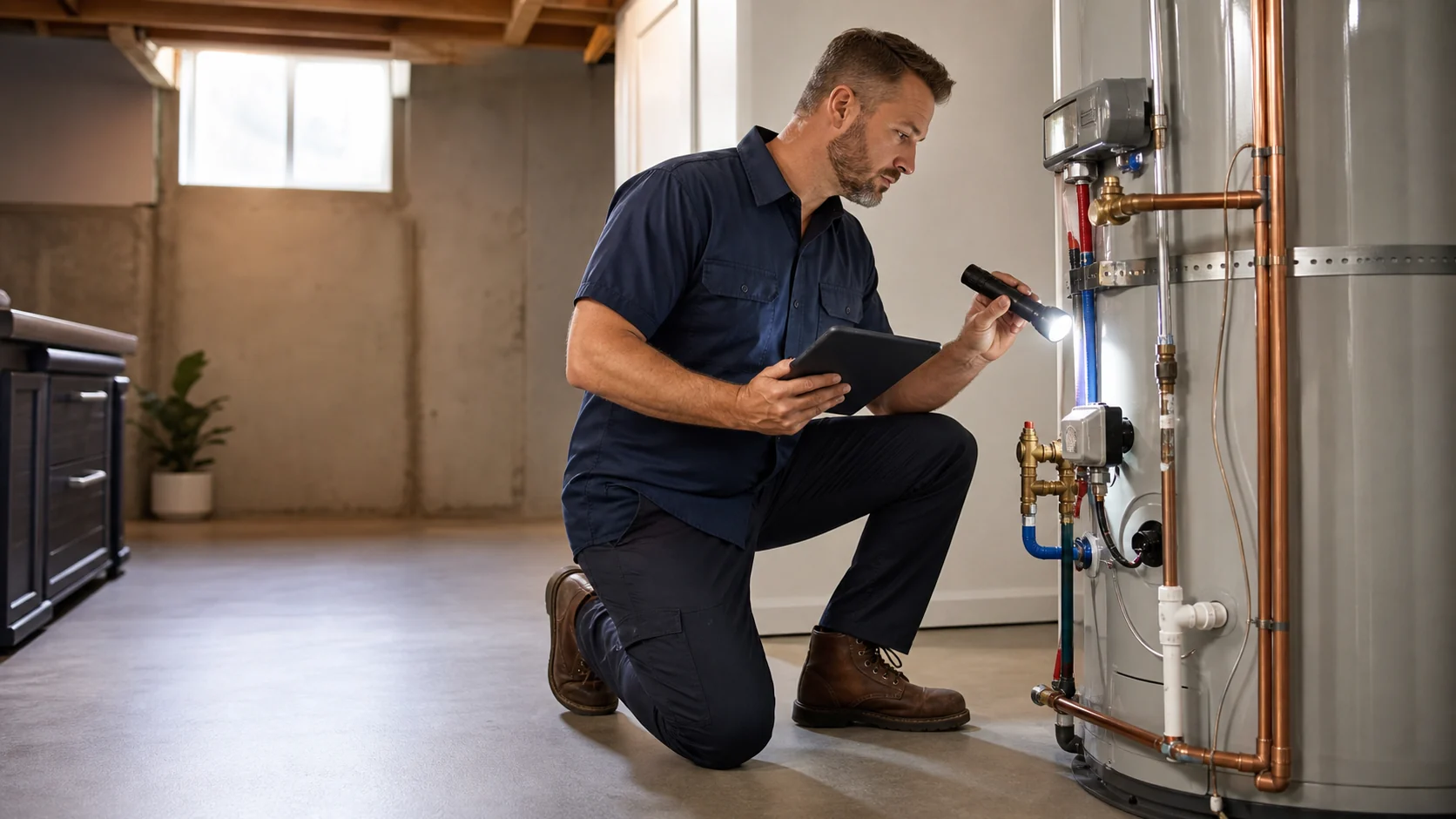
That tiny light near the gas control is easy to misread. Homeowners often count every flash in a long video, search the number, and land on instructions for a different control. A safer first move takes about five minutes: check for an urgent hazard, film several complete cycles, photograph the rating plate, and use the manual for that exact model.
Leave the light alone if the room is unsafe
If you smell gas, hear hissing, have a carbon monoxide alarm, see smoke, soot or scorching, feel ill around the equipment, or find water reaching electrical parts, leave the affected area. Contact the gas utility, fire department, or another appropriate emergency service from a safe place. Do not touch switches, create a flame or spark, remove a burner cover, or keep filming beside the heater.
First, identify what is blinking
This guide is mainly about the small diagnostic light on the gas control of a storage water heater. A tankless heater may show a number on a display, while a heat pump model may show a message, icon, or app notification. Those systems use different troubleshooting steps.
Photograph the entire heater and the control without opening anything. Then photograph the manufacturer's rating plate. Capture the brand, complete model number, serial number, fuel type, and manufacture date if shown. Similar tanks can use different control systems, even within the same brand.
If you have a wall-mounted unit with a digital code, use the tankless error-code checklist instead. If the light is off and a standing pilot repeatedly goes out, see the pilot-light safety guide.
How to record a flash pattern
Do not put your face close to the sight window. Stand where you can see the light safely and record at least three complete cycles. A cycle may include a group of flashes followed by a longer pause. The pause is what separates one code from the next.
Write the pattern in plain language, such as "three quick green flashes, a five-second pause, then repeat." Keep the video. A service provider can often see timing that gets lost in a written count.
Find the manual for the exact model
Use the manufacturer's official document library and enter the complete model number. The control label may also name its manufacturer or show a separate part number, but start with the water heater's rating plate. Match the manual's model family and control illustration to the equipment in front of you.
A random search result for "seven flashes" is not enough. A pattern may describe normal operation, ignition lockout, sensor trouble, temperature limits, or another condition depending on the model. Even the direction for clearing a code can differ. If the manual does not match the label and control, stop there and send the photos to the manufacturer or a qualified provider.
Useful evidence
- • Full model and serial label
- • Twenty- to thirty-second light video
- • Written color, count, and pause pattern
- • Whole-heater and vent photos
- • Hot-water symptoms and start time
Leave for qualified service
- • Opening the burner or control compartment
- • Jumping or bypassing a safety switch
- • Adjusting gas pressure or fuel parts
- • Improvised vent or combustion-air changes
- • Repeated resets after the code returns
Should you reset the heater?
Do not reset it simply to make the light disappear. A reset can erase useful evidence while leaving the cause in place. It can also start another ignition attempt when the surrounding conditions have not been checked.
If the exact manufacturer manual gives an owner-safe restart procedure, the area has no gas, carbon monoxide, fire, venting, leak, or wet-electrical warning, and you understand every step, follow that procedure once. Stop if anything differs from the manual. If the same code returns, the pilot will not remain lit, or the burner behaves abnormally, leave the control alone and request service. Never defeat a safety device or keep cycling the control to force the heater to run.
Utah conditions can be context, not a diagnosis
A cold snap along the Wasatch Front can increase hot-water demand and make utility rooms or combustion-air openings colder. Strong wind, recent home air-sealing work, a new exhaust fan, construction dust, or a utility interruption may also be worth mentioning. None of those details proves what a flash code means.
Homeowners in Salt Lake City, Sandy, Draper, West Jordan, Murray, Provo, Orem, Lehi, and American Fork should still use the exact model documentation. Avoid covering vents or adding a space heater near gas equipment to "fix" a draft. A qualified provider should evaluate repeated ignition, draft, sensor, or combustion faults.
What to send with a service request
Include your Utah city, heater location, fuel type, full model and serial label, flash video, the matching manual link, whether hot water is available, and any recent outage or service. Mention gas odor, a carbon monoxide alarm, soot, scorching, a leak, or illness first. Those details change the response from routine troubleshooting to urgent safety handling.
If the heater is older or has had repeated failures, ask for both the repair scope and a replacement comparison. The age and serial-number guide helps organize the equipment record, and the repair-or-replace guide covers the decision points.
Sources and further reading
- A. O. Smith product literature - an official model-document lookup for manuals and product information. Use the official library for the brand on your heater.
- U.S. Environmental Protection Agency: carbon monoxide detectors - placement, maintenance, alarm response, and the limits of carbon monoxide alarms.
- U.S. Consumer Product Safety Commission: carbon monoxide safety publication - public safety background on carbon monoxide sources, symptoms, alarms, and emergency response.
Have the flash video and model label?
Send both with your city, fuel type, hot-water symptoms, and any recent outage or service. If there is a gas odor, carbon monoxide alarm, smoke, soot, scorching, or water on electrical parts, leave the unsafe area and use the appropriate emergency channel first.
Request water heater help