
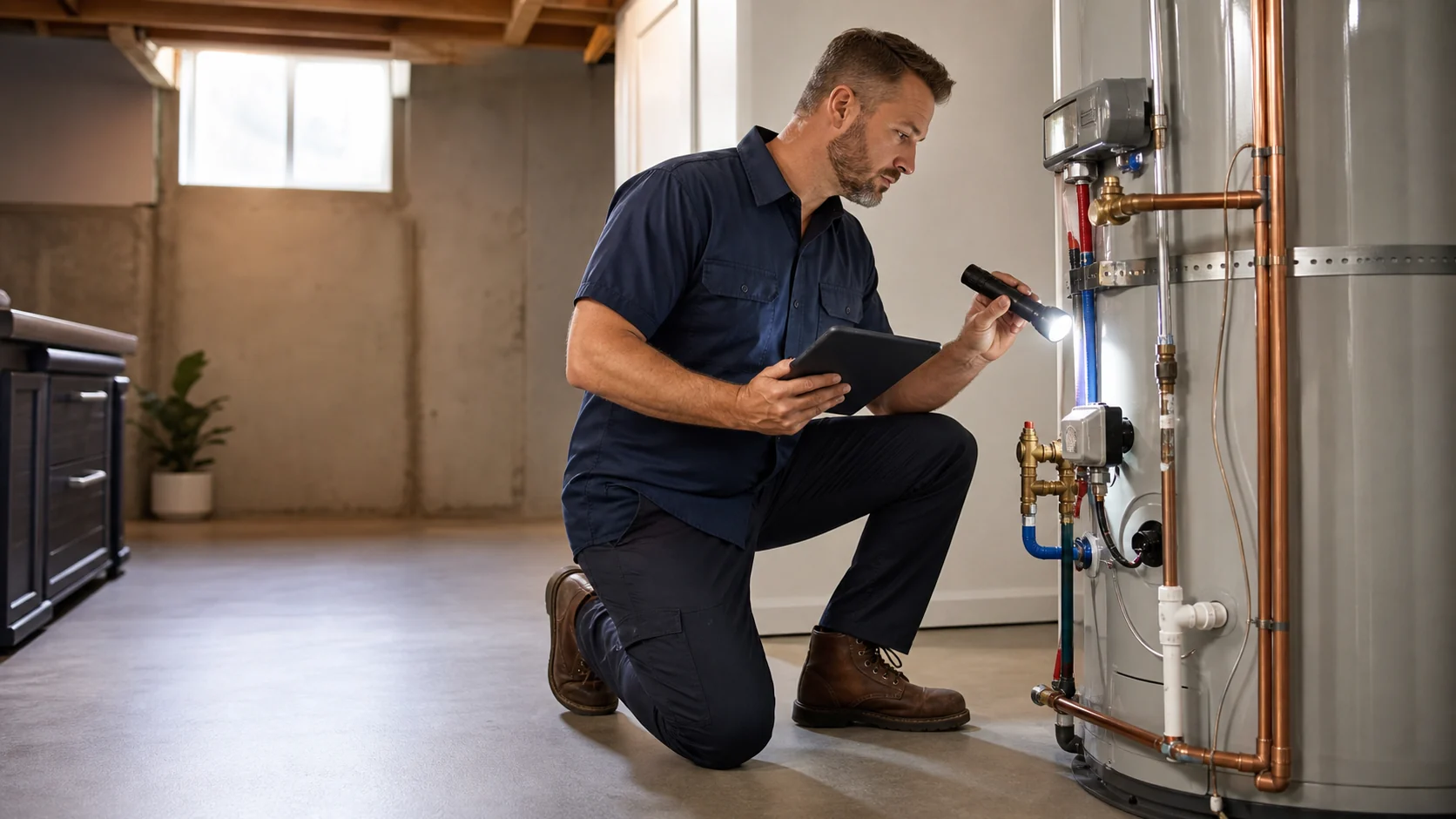
If a Utah home has both a water softener and a storage water heater, the heater usually receives softened water. That can cut down on calcium-carbonate scale. It can also change how quickly a sacrificial anode rod is consumed. There is no useful one-size-fits-all rule such as "softened water ruins tanks" or "a softener solves every sediment problem." Check the equipment, the water, and the manufacturer's instructions.
Start with two labels, not a guess
Photograph the softener model and the water-heater rating plate. Find the manuals for both. The heater manufacturer may give anode-inspection guidance, while the softener manual explains hardness and regeneration settings. Do not change either appliance based on a generic online setting.
What the softener changes
Water hardness is mainly a measure of dissolved calcium and magnesium. When hard water is heated, calcium-carbonate deposits can form inside a tank, on an electric element, or in a tankless heat exchanger. The U.S. Geological Survey notes that this scale can shorten equipment life, raise water-heating costs, reduce electric-heater efficiency, and clog piping.
A conventional ion-exchange softener removes much of that hardness before the water reaches the heater. Less hardness usually means less scale, but the softener does not remove every dissolved substance and it does not repair scale that is already present. A tank can still collect debris from plumbing work, corrosion products, or the water supply.
What happens to the anode rod
Most steel storage tanks use a sacrificial anode rod to protect the tank from corrosion. The rod is supposed to wear away. How fast it wears depends on the water chemistry, hot-water use, anode material, tank design, and whether a softener is installed.
A. O. Smith's homeowner maintenance guidance specifically lists a water softener as one factor in anode life and recommends regular inspection. That does not mean every softened-water tank needs the same replacement interval. Use the heater manual and ask a qualified provider to inspect the rod without damaging the tank, hot-water piping, or warranty coverage.
A practical check after installing or adjusting a softener
- Save the starting settings. Photograph the programmed hardness, regeneration schedule, and salt level before anyone changes them.
- Confirm the plumbing path. Ask the installer which fixtures receive softened water and whether the water heater is on that line. Exterior hose bibs and some cold kitchen taps may bypass the softener.
- Request a hardness test. Test the incoming hard water and a softened cold-water tap. A test result is more useful than judging by how slippery the water feels.
- Watch the first few weeks. Note changes in hot-water odor, taste, color, pressure, temperature, salt use, and regeneration frequency.
- Add an anode question to annual service. Give the provider the heater age, softener installation date, water test, and both model numbers.
Symptoms that deserve a closer look
Do not over-soften the water
A softener should be set from a real hardness result and the model's instructions. Raising the programmed hardness "just to be safe" can waste salt and water through unnecessary regeneration. It is not a water-heater repair.
If the home is served by Salt Lake City or another public system, start with the utility's current water-quality report. Water sources and conditions can change. The hardness at a neighbor's house, or a number from an old internet post, may not match your supply. A point-of-use test at the house gives the installer a better starting point.
Tankless units need model-specific care
Softened water may reduce scale in a tankless heat exchanger, but it does not eliminate maintenance. Manufacturers set their own water-quality limits and service procedures. Look up the exact model manual before descaling, cleaning a filter, changing treatment settings, or choosing chemicals.
If the unit displays an error code or cannot hold temperature, save the code and operating conditions. The Utah tankless maintenance guide explains what to document before requesting service.
Safety boundaries
- Do not remove an anode rod from a hot or pressurized tank.
- Do not open electrical covers, alter gas controls, or disconnect venting to reach an anode.
- Do not add chemicals to a potable-water system unless the appliance manufacturer and a qualified provider approve the procedure.
- Do not plug a relief line or treat a dripping temperature-and-pressure relief valve as a softener adjustment.
- Stop if you smell gas, see water on wiring, hear a carbon monoxide alarm, or find an active tank leak.
For hot-only sulfur odor, use the rotten-egg smell guide. For discoloration, compare the steps in the rusty or brown hot-water guide.
Questions to put in a service request
- Does the water heater receive softened water?
- What are the incoming and softened hardness results?
- How old are the heater, softener, and anode rod?
- Does the heater manual change the inspection schedule for softened water?
- Are there odor, color, sound, pressure, or recovery-time symptoms?
- Would an anode inspection, water test, or tankless service make sense before changing equipment?
Sources and further reading
- U.S. Geological Survey: Hardness of Water explains calcium and magnesium hardness and how heating hard water can create scale.
- A. O. Smith: Water Heater Maintenance covers sacrificial anode rods, sediment, and the factors that affect anode life.
- U.S. EPA: Consumer Confidence Reports helps homeowners find public water-system quality reports.
- Salt Lake City Public Utilities: Water Quality links local drinking-water reports and water-quality contacts.
Have a softener and a water-heater symptom?
Send your Utah city, both model labels, heater age, hardness test results, and what changed. That is enough for a useful first conversation without opening the tank.
Request Utah water heater help