
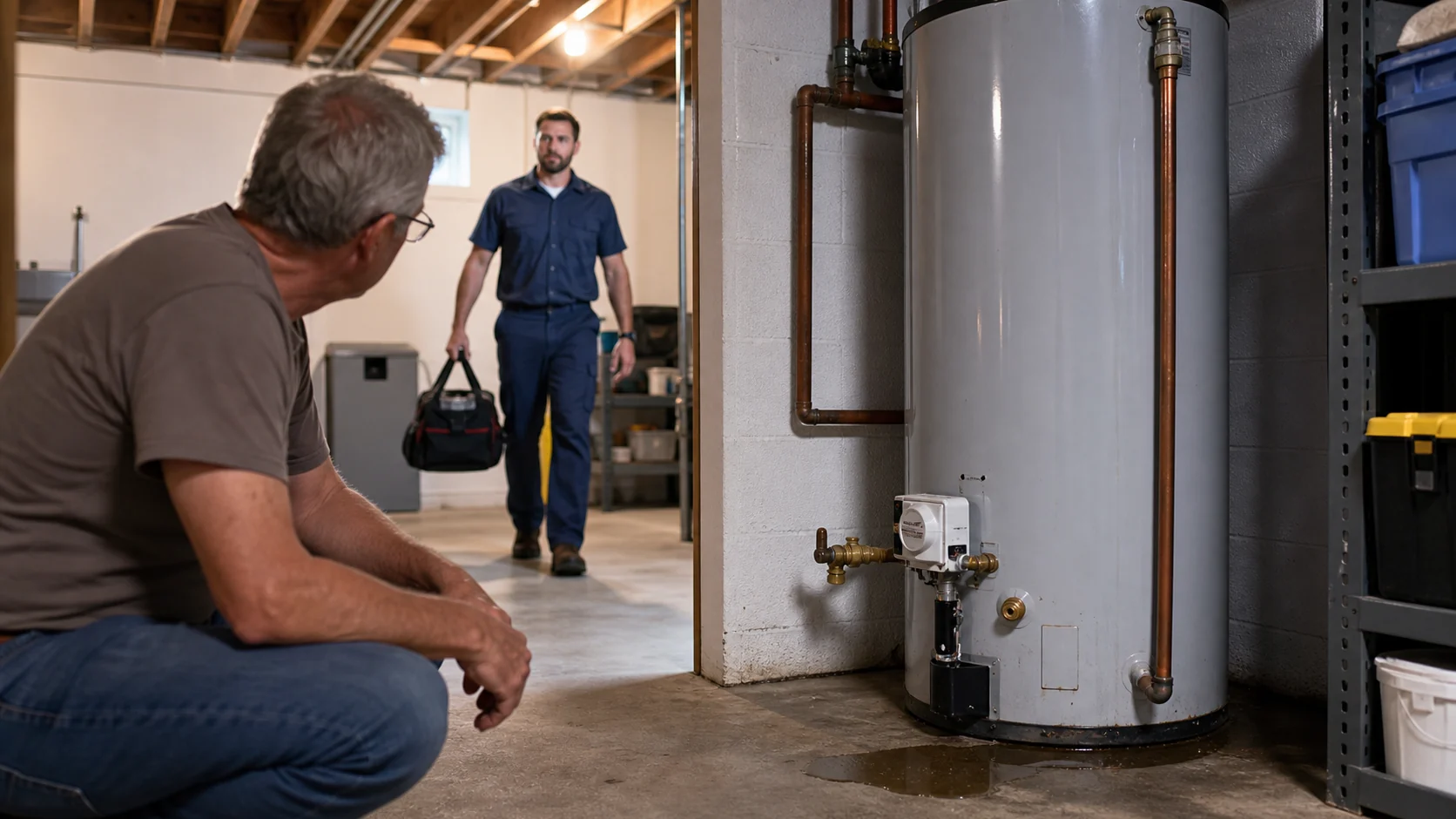
A dry floor in the morning does not rule out a water heater leak. Some leaks show up only after the burner or elements run, which is why a puddle may appear after laundry, baths, or several showers and then seem to vanish.
You can learn a lot from the wet path and the clock without opening the heater or touching a hot, pressurized fitting. This guide is for observation and service preparation. It does not ask you to operate the relief valve, remove covers, adjust gas controls, test live wiring, or install pressure equipment.
Treat these signs as urgent
Move away from the equipment if you smell gas, hear hissing, see smoke or soot, have a carbon monoxide alarm, or find water touching wiring, an electrical panel, or a powered appliance. Call the gas utility, fire department, emergency services, or a qualified provider as the situation requires. Keep people away from spraying or very hot relief-valve discharge.
First, confirm that the leak follows a heating cycle
Start with a normal household event that already happened, such as a shower or dishwasher cycle. Do not waste hot water to force the heater on. From a dry, safe spot, note when hot-water use ended, when the heater began recovering if you can hear it, and when moisture first appeared.
- Photograph the whole heater, drain pan, and surrounding floor before wiping any easy-to-reach floor water.
- Check again about 15 minutes after hot-water use and once more after the heater becomes quiet.
- Follow the visible wet trail upward with your eyes. Do not reach behind the tank or wrap towels around hot pipes.
- Repeat the observation after the next normal hot-water use. Two matching cycles are more useful than one unexplained puddle.
Write down whether the water begins at the discharge pipe, a top connection, the drain valve, the bottom edge, a condensate line, or somewhere outside the heater. A phone video can capture a brief drip that stops before a provider arrives.
What the starting point can tell you
Why pressure can create an after-shower drip
Hot-water use brings cold replacement water into a storage tank. That water expands as the heater brings it back to the thermostat setting. In some homes, a check valve, backflow device, pressure-reducing valve, or other system feature prevents the extra volume from moving back toward the water main. Pressure can then climb during recovery.
A properly selected expansion tank gives that added volume somewhere to go. If the home has no expansion control, or if an existing expansion tank has lost its air charge or failed internally, the temperature and pressure relief valve may weep. The relief valve is emergency protection, not a routine expansion-control device. Never cap, plug, clamp, or reduce its discharge pipe.
The timing is a clue, not a diagnosis. A qualified provider can measure static and heating-cycle pressure, inspect the relief valve, identify whether the plumbing system is closed, and check an existing expansion tank. Our Utah expansion tank guide explains what to include in that service request.
Condensation can mimic a leak, but do not assume
Combustion produces water vapor, and a gas heater can condense when a cold tank and flue surfaces meet hot combustion gases. This is more likely during a long recovery or startup with unusually cold inlet water. Condensing tankless and high-efficiency equipment also has a designed condensate drain.
Condensation should follow the route described in the exact model manual. Repeated puddles, water from the tank jacket, a blocked drain, corrosion, soot, changed flame behavior, or moisture that continues after recovery should not be dismissed as normal. Use the condensation versus leak guide to compare the wet path before requesting service.
Make a service note that saves time
Send the provider a short timeline instead of saying only that the heater leaks "sometimes." Include:
- Utah city and the heater's location, such as basement, garage, closet, or utility room.
- Fuel and type: gas tank, electric tank, heat pump, or tankless.
- Model and serial number photos plus the approximate installation age.
- What happened before the drip, when it started, and how long it lasted.
- The highest visible point where water appeared.
- Whether the discharge pipe, drain pan, condensate line, or tank seam was wet.
- Any recent water-meter, pressure-reducing-valve, softener, backflow, or water-heater work.
Wasatch Front inlet-water temperatures and utility-room conditions change through the year, so tell the provider if the symptom began during a cold snap or after the heater had been off. Hard-water deposits may make a small intermittent drip easier to spot, but mineral crust does not prove which part failed.
When replacement belongs in the conversation
A repair may be possible when water comes from an external fitting, condensate drain, pressure-control component, or replaceable valve. Water emerging from the tank body, welded opening, or jacket is a different problem. Ask the provider to identify the source in writing before approving work.
If the tank itself is leaking, compare a complete installed replacement rather than a bare equipment price. The Utah water heater replacement cost guide covers capacity, fuel, venting, electrical work, drain protection, permits, and haul-away. For active spreading water, use the leaking water heater emergency steps.
Sources and further reading
- A. O. Smith Technical Bulletin 45: Thermal Expansion - explains closed plumbing systems, heating-cycle pressure rise, and the role of properly sized expansion control.
- A. O. Smith Technical Bulletin 52: Leaking Temperature and Pressure Relief Valve - separates threaded leaks, pressure-related weeping, and large hot-water discharge.
- U.S. Department of Energy: Storage Water Heaters - storage-heater operation, qualified installation, and model-specific maintenance guidance.
- Utah State Fire Marshal: Home Fire Safety - fuel-burning appliance venting, carbon monoxide alarms, and qualified inspection guidance.
Have a cycle-timed water heater leak?
Send your Utah city, heater type, model photo, leak-starting point, and a short heating-cycle timeline. If water is spreading or there is a gas, carbon monoxide, smoke, or electrical warning, use the appropriate emergency service first.
Request water heater help