
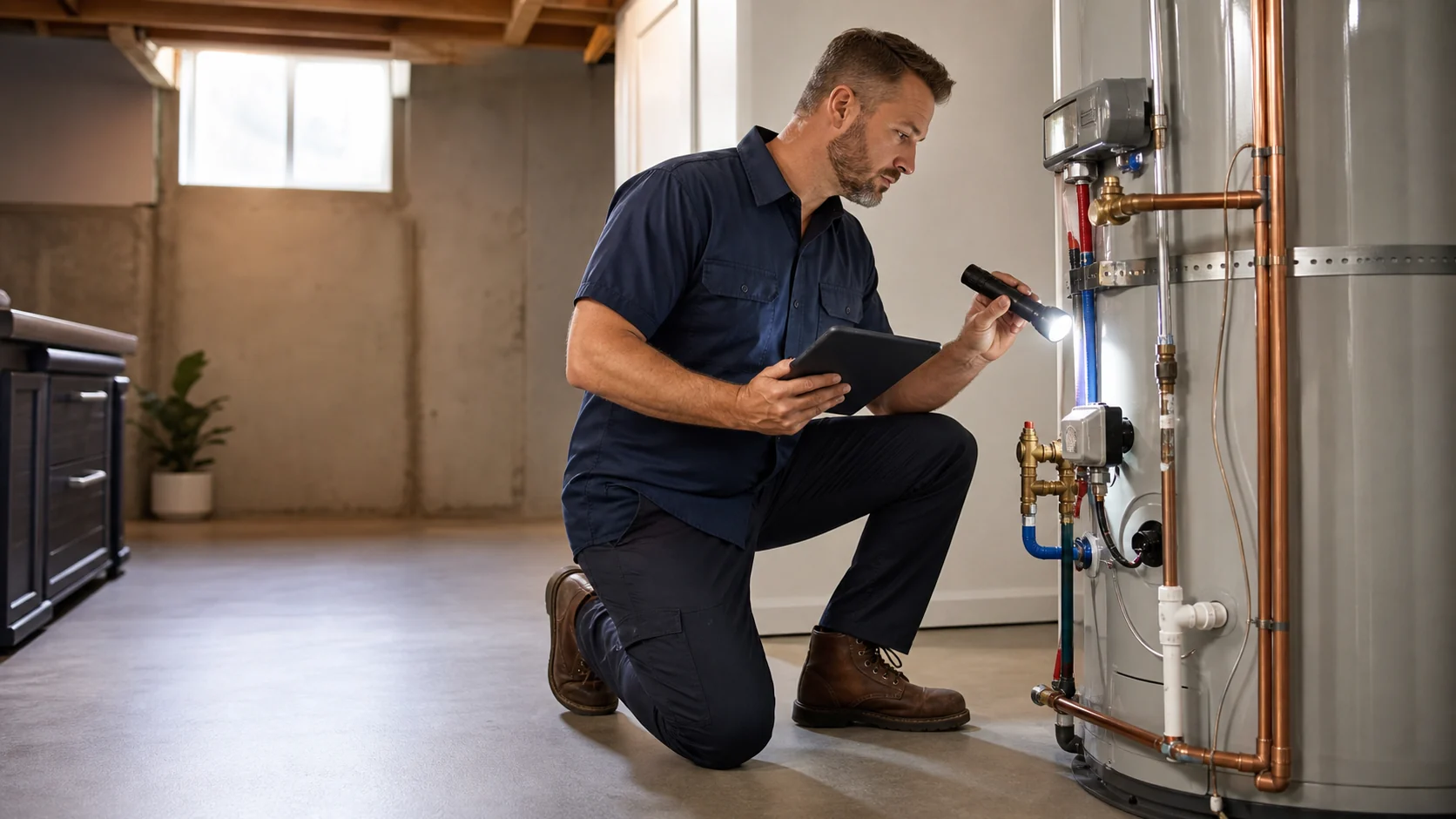
One cold shower does not prove the water heater is failing. Three back-to-back showers can empty a healthy tank. But a tank that still has not recovered long after normal use, or suddenly takes much longer than it used to, deserves a closer look.
Keep the test outside the cabinet
Do not remove electrical covers, touch wiring, open a sealed burner compartment, relight a pilot contrary to the owner's manual, or repeatedly reset a breaker or high-limit switch. Leave immediately and contact the gas utility or emergency services if you smell gas. Treat a carbon monoxide alarm, scorched wiring, active leak near electrical parts, or dangerously hot water as an urgent safety problem.
Start with a rough expectation, not a deadline
A. O. Smith gives broad examples of about 30 to 40 minutes for a conventional gas tank to heat from empty and about 60 to 80 minutes for a conventional electric tank. Those are examples, not pass-fail limits. Tank capacity, burner or element size, temperature setting, incoming water temperature, sediment, equipment condition, and the exact model all change the result.
A tankless unit works differently. It heats water during use rather than reheating a stored tank. That does not make hot water appear instantly at a distant bathroom. The cold water already sitting in the pipe still has to clear, so a long wait at the faucet may be a delivery problem rather than slow heater recovery. See the slow hot-water delivery guide for that test.
Run a useful recovery-time check
- Pick a normal day. Do not run the dishwasher or washing machine during the check.
- Write down what used the hot water. Include the number and approximate length of showers. A vague "we used some hot water" will not help with sizing or diagnosis.
- Start the clock when the last heavy use ends. Leave the temperature control alone.
- Check one familiar faucet at sensible intervals. Use the same fixture and usual handle position. Keep hands out of very hot water and supervise children.
- Record when normal hot water returns. Repeat on another comparable day before treating a few minutes of variation as a fault.
For a newly installed or recently drained heater, use the startup procedure and expected heating time in that model's manual. Confirm the tank is full before energizing an electric heater; powering dry elements can damage them. A qualified installer should handle startup when there is any doubt.
First hour rating explains more than tank size
A 50-gallon label does not mean a household gets exactly 50 gallons of useful hot water and then waits for a full reset. Bradford White defines first hour rating as the estimated maximum hot water a fully heated storage unit can supply in one hour. It combines storage volume with recovery rate.
Look for the first hour rating on the EnergyGuide label, product specification sheet, or manufacturer documentation for the exact model. Compare that figure with peak use, such as showers plus laundry in the same hour. If demand regularly outruns the rating, the heater may be working as designed but sized poorly for the routine. The Utah water heater sizing guide explains how to prepare for a replacement quote.
Why Utah winters can stretch the wait
Water entering the heater can be colder in winter, especially along the Wasatch Front. The heater then has to create a larger temperature rise to reach the same setting. That can reduce how much hot water a tankless unit supplies at a chosen temperature and can lengthen recovery for a storage unit.
Do not diagnose a bad heater from a summer-to-winter difference alone. Compare similar household use, check the model's specifications, and note whether the change is seasonal or sudden. Sediment and scale can muddy the picture in hard-water areas, but flushing an old tank is not automatically a safe cure. Read the Utah hard-water and sediment guide before deciding on maintenance.
Clues that point to service instead of patience
- The recovery time changed sharply even though household use did not.
- An electric tank has only a small amount of hot water, then goes cold, which can occur when one heating element or its control is not working.
- A gas heater repeatedly loses its pilot, shows a fuel or ignition error, produces soot, or has venting or carbon monoxide concerns.
- The breaker trips again, a reset will not hold, or there is buzzing, heat, scorching, or moisture near electrical parts.
- The tank rumbles or pops while recovery has slowed, or hot-water pressure has fallen.
- The water becomes scalding, temperature swings are severe, or every fixture stays lukewarm.
These clues do not identify the failed part by themselves. They give a qualified provider a better starting point. If you are deciding whether an older unit is worth another repair, use the repair-or-replace checklist and check the warranty records before approving work.
What to send with a service request
Photograph the full rating label, note the model and serial number, fuel type, tank size, city, approximate age, temperature setting as found, and any display code. Add the timed recovery notes and the hot-water uses that came before the test. For homes in Salt Lake City, Sandy, Draper, West Jordan, Provo, Orem, Lehi, or American Fork, mention whether the unit sits in a cold garage, basement, utility closet, or finished space.
Sources and further reading
- A. O. Smith: how long a water heater takes to heat up — broad gas, electric, tank, and tankless timing examples plus factors that slow recovery.
- Bradford White: what first hour rating means — a concise manufacturer definition connecting storage volume and recovery rate.
Still waiting too long for hot water?
Send the model-label photo, fuel type, city, what used hot water, and your timed recovery notes. That is enough to start a useful repair, sizing, or replacement conversation without opening the heater.
Send the recovery details