
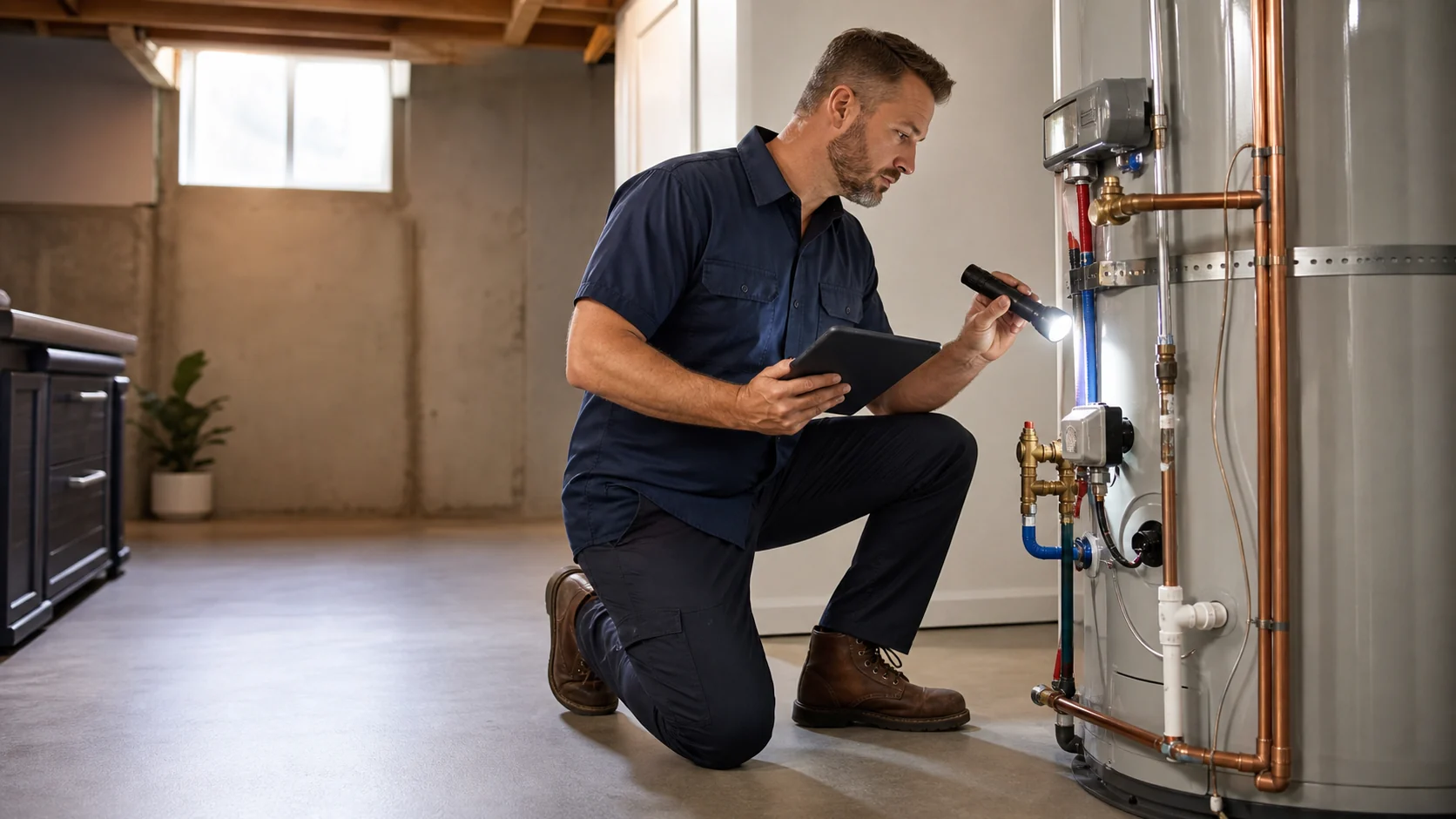
A water heater usually gets attention at the worst possible time: the shower is cold, the pan is wet, or a status light is blinking after dinner. That is when somebody asks for the model number, installation date, warranty, and last service visit. Most homeowners have none of them handy.
You do not need a complicated home-maintenance app. One folder, a few clear photos, and a one-page log are enough. The goal is to help a qualified technician identify the equipment and see its history without turning the utility room into a detective story.
Record what you can see. Do not take the heater apart.
Keep covers, burner doors, electrical panels, vent connections, gas fittings, relief valves, and pressurized plumbing alone. If you smell gas, see smoke or scorching, hear a carbon-monoxide alarm, find water near wiring, or see a tank actively leaking, leave the area as appropriate and call the utility, emergency services, or a qualified professional. Documentation can wait.
Start with six photos
Stand back far enough to capture the heater and the space around it, then move closer for labels and connections. Use the phone's normal camera rather than a social app that compresses the image. Check each photo before leaving the room; metallic labels are good at reflecting a flash straight back at the lens.
Photograph now
- 1. The whole heater and utility space
- 2. Rating plate with model and serial number
- 3. Top piping and nearby shutoff valves
- 4. Lower controls, drain valve, and floor area
- 5. Gas vent or tankless exhaust and intake, if present
- 6. Drain pan, relief discharge, condensate, and nearby drain route
Write down
- • Manufacturer, full model, and serial number
- • Fuel and equipment type
- • Tank capacity or tankless input/output details
- • Installation date, if known
- • Installer and service company names
- • Warranty, permit, and inspection records
The rating plate matters more than the logo on the front. Manufacturers often use similar cabinets for many models, while maintenance instructions and replacement parts can vary. If you are unsure what the label means, use the water heater identification guide and keep the original photo instead of typing a number that may contain a mistaken zero or letter O.
Build a log that a technician can scan in a minute
A useful entry says what happened, where it happened, and what changed. "Serviced heater" says almost nothing. "Replaced the upper electric element after hot water fell to one short shower; invoice and part number saved" gives the next technician a starting point.
Keep invoices, even when the repair seems minor
Save the diagnosis and completed work, not just a credit-card receipt. A good service record identifies the unit, visit date, complaint, parts replaced, maintenance performed, and any recommended follow-up. Keep before-and-after photos when a leak, vent issue, corroded fitting, drain problem, or installation correction is involved.
If a company tells you a part is covered by the manufacturer but labor is not, save that explanation with the claim number. Product warranties and installer workmanship coverage are different, and both can depend on terms that vary by model and company. The water heater warranty guide has a claim-prep checklist.
Track the symptom, not your diagnosis
Write "popping starts about five minutes after the burner starts" rather than "tank is full of sediment." Record whether the issue affects every hot tap or one fixture, whether cold water is affected, and whether it happens all day or only after heavy use. That detail is often more helpful than naming a suspected part.
- For a leak, photograph the highest visible wet point and the path into the pan or floor.
- For an error light or tankless code, capture the full flash pattern or display before any manual-approved reset.
- For hot-water capacity, note shower length, simultaneous use, recovery time, and whether performance changed suddenly.
- For odor or discoloration, compare hot and cold samples at more than one fixture and check the water provider's notices.
- For a higher bill, compare billing days and utility rates before assuming the heater used more energy.
Useful starting points include the status-light guide, top-of-heater leak checklist, and not-enough-hot-water guide.
Save model-specific instructions
Download the current manual from the manufacturer's official site and name the file with the full model number. Generic maintenance schedules can conflict with a unit's design, local water conditions, installation, or warranty terms. A tankless system may have filters and model-specific service procedures. A heat-pump unit has air and condensate requirements that a standard electric tank does not.
If a qualified provider recommends flushing, anode inspection, descaling, filter service, or another recurring task, ask for the interval and the exact reason in writing. Utah water hardness varies by water source and community, so a calendar copied from a generic article is not a substitute for the manual and a local assessment.
Make the folder easy to hand over
Create a folder named for the property and appliance, such as Home - water heater. Inside it, keep the six baseline photos, manual, original quote, paid invoice, warranty, permit and inspection record, service invoices, and a simple text or spreadsheet log. Back it up somewhere another household member can reach during an emergency.
When you sell the home, leave copies that help the next owner understand the appliance. Keep your own originals when they contain payment details or other personal information. When you replace the heater, archive the old unit's folder instead of mixing its repairs with the new model.
A quick Utah check before hiring service
For work that requires a licensed trade professional, use Utah's official license lookup and match the name or license number to the quote. Save the search date and result with the invoice. Permit and inspection requirements are set by the local jurisdiction, so homeowners in Salt Lake City, Sandy, Draper, Provo, Orem, Lehi, and nearby cities should confirm the process with the city or county responsible for the property.
Records do not prove that an installation is safe, and they do not replace an inspection. They give the homeowner, service company, manufacturer, and local inspector a cleaner account of what equipment is present and what has already happened.
Sources and further reading
- A. O. Smith product literature - an example of an official manufacturer library for model-specific manuals and documentation.
- U.S. Consumer Product Safety Commission recalls - official recall notices that can be searched using product and model details.
- Utah Division of Professional Licensing lookup - Utah's public search for professional and business license information.
- The official owner and installation manuals for the exact model in the home, plus the local city or county building department when permit records are needed.
Have the photos but need help reading the situation?
Send the city, heater type, model-label photo, age if known, current symptom, and any recent service history. We can review the request and coordinate the next step.
Request water heater help