
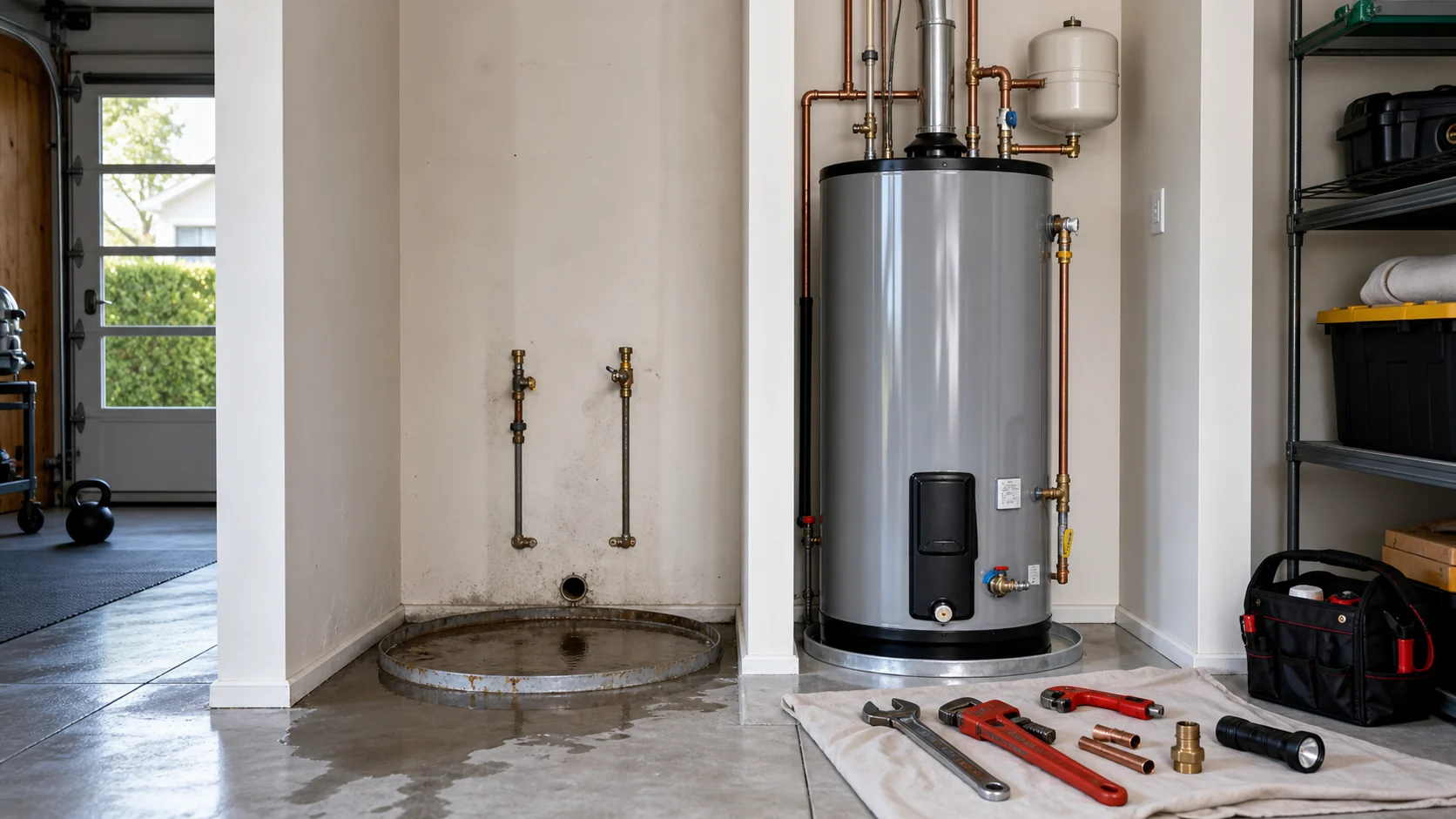
Moving a water heater a few feet can free up a pantry, simplify a basement remodel, or get an aging tank away from finished flooring. It can also turn a routine replacement into a plumbing, gas, electrical, venting, framing, and permit project.
Before asking for a price, mark the exact old and proposed locations. A contractor can give you a much better answer with those two points, a heater-label photo, and a few room measurements than with a request to "move it to the garage."
Do not disconnect or drag the heater yourself
A storage tank can hold scalding water and is extremely heavy. Gas piping, vents, 240-volt wiring, relief-valve discharge piping, and pressurized water connections are not prep work for an unqualified homeowner. If you smell gas, hear hissing, see smoke or soot, have a carbon monoxide alarm, or find water near electrical equipment, leave the unsafe area and contact the gas utility, fire department, or emergency services as appropriate.
Start with the reason for moving it
A relocation makes more sense when it solves a real problem. Write down what the current location prevents you from doing and what a successful move needs to preserve.
- Remodel space: you need the current closet, laundry area, or basement corner for another use.
- Water-damage risk: the heater sits beside finished flooring or above occupied space without a practical drainage plan.
- Service access: the current enclosure is too tight for inspection, repair, or replacement.
- Equipment change: a heat-pump or tankless model needs a different location, air path, vent route, condensate drain, electrical supply, or gas capacity.
If the only goal is leak protection, a correctly planned drain pan, alarm, automatic shutoff, or nearby replacement may cost less and disturb less of the house. Use the finished-basement leak-planning guide before assuming relocation is the best fix.
Check the proposed location on paper first
Take photos from the doorway and from each wall. Measure the room, door opening, stair width, ceiling height, and the narrowest turn on the route from outside. Include nearby shelves, cars, stored fuel, laundry equipment, floor drains, windows, doors, furnace equipment, outlets, and the electrical panel.
The fuel type decides much of the scope
Standard gas tank: the contractor must evaluate the gas supply, combustion air, vent connector, vent system, clearances, and the exact model's installation instructions. An existing chimney or shared vent does not automatically work from a new room. Do not plan the route by measuring the shortest hole to an outside wall.
Power-vent or direct-vent gas: the approved pipe material, diameter, length, elbows, slope, intake arrangement, and termination clearances are model-specific. The blower also needs power. See the power-vent water heater guide for the exterior clues worth photographing.
Electric resistance or heat pump: a storage tank may need a dedicated 240-volt circuit sized for the exact equipment. Heat-pump models add condensate disposal, noise, airflow, temperature, and room-volume questions. A garage or small closet is not automatically suitable just because the tank fits. Compare the proposed room with the Utah heat-pump water heater checklist.
Tankless: moving to a wall does not remove the utility work. Gas tankless units can require substantial gas and vent planning; electric tankless units can require large electrical capacity. Both need a serviceable water route, isolation provisions specified by the manufacturer, and a drainage plan where condensate applies.
Longer pipes affect comfort too
A new location farther from bathrooms and the kitchen can increase the wait for hot water and the amount of cooled water left in the line between uses. Ask the bidder to estimate the new pipe route rather than discussing only the heater.
If the route gets much longer, compare pipe insulation and a properly controlled recirculation design. Recirculation can shorten the wait, but a poorly controlled pump can waste energy, warm the cold line, or make a tankless system cycle more often. The slow hot-water delivery guide and recirculation guide explain those tradeoffs.
Ask the local building department before work starts
Permit requirements and the reviewing authority depend on the property's city or unincorporated area. Do not assume a nearby city's process applies to your address. Salt Lake City's published permit page covers alterations to plumbing, mechanical, gas, and electrical systems. The Greater Salt Lake Municipal Services District specifically lists water-heater installation or replacement as permit work, and Orem says electrical, plumbing, heating, and air-conditioning work generally needs a permit application.
A relocation can involve more than one trade review. Ask which permit covers the work, who will obtain it, which inspections are required, and whose name will appear on the permit. Save the closed permit and final inspection with the model, serial number, invoice, and warranty records.
Get a written quote that includes the whole move
Two relocation quotes can look similar while covering very different jobs. Ask each bidder to identify the same equipment and the same finish point.
- Exact manufacturer and model number, fuel, capacity, efficiency rating, and warranty.
- New hot and cold piping route, insulation, shutoff, and any recirculation changes.
- Gas piping and venting, or electrical circuit and panel work, when applicable.
- Drain pan, relief discharge, condensate, and leak-control plan.
- Platform, wall, door, drywall, roof, siding, cabinet, or concrete work and who repairs each opening.
- Permit, inspection, haul-away, startup, cleanup, and protection for floors and stairs.
- What happens if concealed framing, wiring, piping, or vent problems change the price.
Use the water heater quote comparison checklist to put bids side by side. A low equipment price is not a low project price if wall repair, electrical work, drain routing, or permits are left out.
Send this six-photo relocation packet
- The full current heater and surrounding room.
- The current rating plate with model, serial number, fuel, and electrical data readable.
- The current piping, vent, drain pan, and electrical or gas connection from a safe distance.
- The proposed location from the doorway.
- The proposed floor, walls, ceiling, drain, and nearby utilities.
- The complete route between the old and new locations, including stairs and tight turns.
Sources and further reading
- Salt Lake City Building Services: building permit applications - the city's permit process and contact information for work that alters regulated building systems.
- Greater Salt Lake Municipal Services District: do I need a building permit? - examples of permit-required work in the district, including water heaters.
- Orem Building Safety - local permit and inspection information for Orem properties.
- Utah Legislature: state construction-code amendments affecting residential plumbing - current Utah amendments, including water-heater pan and seismic-bracing provisions.
- A. O. Smith product literature - find the installation and use manual for an exact model before evaluating location, venting, or startup requirements.
Planning a relocation in Salt Lake or Utah County?
Send the city, reason for moving the heater, current model-label photo, old and proposed locations, access measurements, and fuel type. We can review the request and help coordinate the next step.
Request water heater help